Key takeaways
- Link building and digital PR can use the same research and outreach, but they often begin with different primary objectives.
- Link building usually focuses on relevant editorial references to useful pages; digital PR also seeks story reach, coverage and audience understanding.
- An editor may publish a mention without a backlink, add a qualified link or decline the story entirely.
- Compare tactics by audience, asset, editorial fit and measurement rather than a promised placement count.
- Record outputs separately from outcomes, and disclose assumptions before claiming search or business impact.
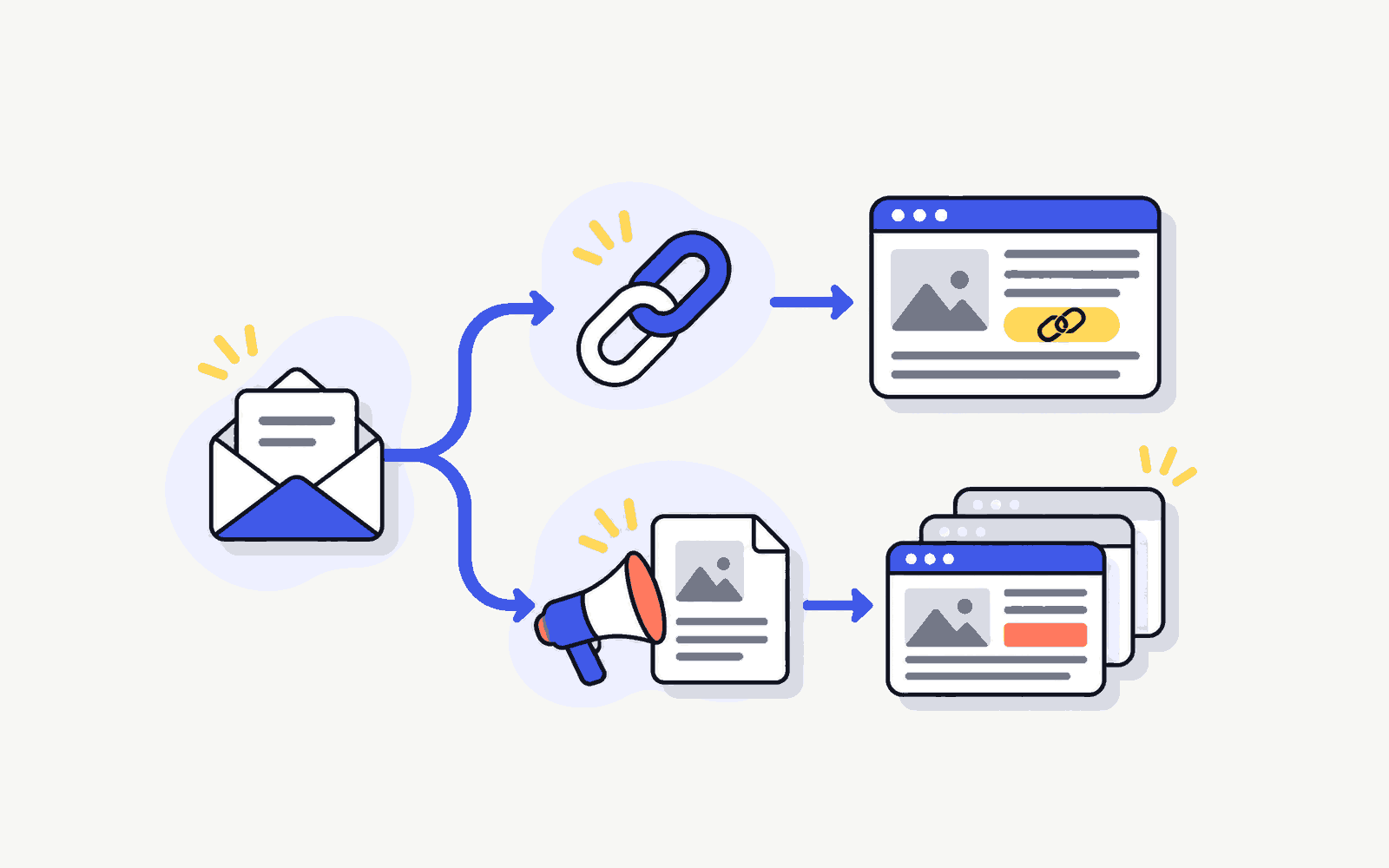
An editor might link to your calculator because it helps readers do the maths. They might cover your research because it gives them a story to report. That difference is a useful starting point for comparing link building and digital PR.
For a beginner, the useful question is not which label sounds more advanced. Ask who needs the information, what evidence or resource you can offer, why a publisher would use it and what a successful response would look like. Neither approach guarantees coverage, backlinks, rankings or sales.
Where the approaches overlap
Both approaches can involve original research, useful resources, expert commentary, prospect research and personal outreach. Both depend on relevance and editorial judgment. A well-supported data story can earn news coverage and links to its methodology. A practical guide promoted to a specialist publication can become a source for a journalist’s later story.
The difference is usually the primary planning emphasis. A link-building campaign might begin with a particular resource that deserves a relevant citation. A digital PR campaign might begin with a newsworthy finding or expert perspective that matters to a defined audience. That distinction helps explain the work, but it does not mean every campaign fits neatly into one box.
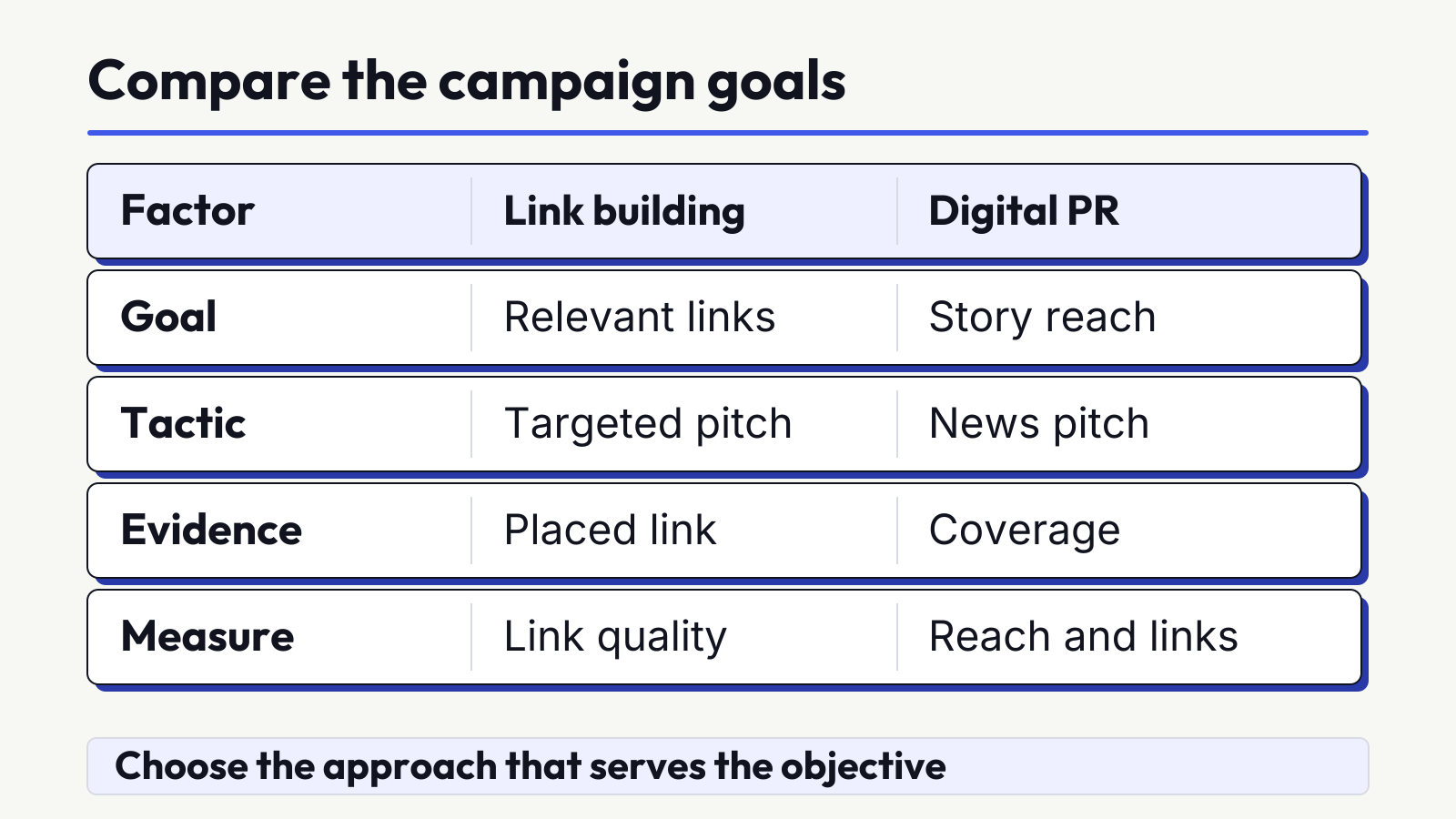
| Dimension | Link building emphasis | Digital PR emphasis |
|---|---|---|
| Primary goal | Relevant editorial links to useful pages | Credible story coverage, attention and communication outcomes |
| Starting asset | A guide, dataset, tool or other citable page | A story, finding, campaign or expert perspective |
| Typical outreach | A targeted resource or contribution pitch | A news or commentary pitch matched to a publication |
| Immediate evidence | The linking page, destination and context | Coverage, messages, mentions and any links |
| Main caution | Link count alone does not show quality or business value | Coverage count or estimated reach does not show audience response |
Start with the objective and audience
Write one primary objective before choosing a tactic. “Help specialist buyers discover our implementation research” is different from “explain a new industry finding to a wider audience.” Both need an audience definition, a useful asset and evidence, but they may call for different publishers, messages and measures.
Then specify the audience’s question. A journalist needs a defensible finding, timely context or credible commentary. An editor maintaining a resource guide needs something useful that fills a genuine gap. A relevant asset can still receive no response if the pitch misunderstands the publication’s readers or arrives without a clear editorial reason.
Choose the destination page deliberately. If the pitch refers to a research method, the destination should provide the method. If it offers a practical checklist, the page should let the reader use that checklist. SERA’s keyword research guide for beginners explains how to separate a page’s topic and intent before planning the next step.
Compare the work behind the pitch
Link-building activities
Common activities include promoting an original resource, suggesting a genuinely relevant addition to a maintained guide, contributing an expert explanation and asking an editor to correct a missing reference. The asset must provide value beyond the desire to obtain a link. A generic article does not become useful simply because a campaign needs placements.
Research the specific page, not just the website’s headline metrics. Check whether the topic, readers, editorial standards and proposed citation fit. An irrelevant placement on a strong-looking domain can be less useful to readers than a closely relevant reference in a specialist explanation. Record why the context makes sense.
Digital PR activities
Digital PR can involve original data stories, expert responses, creative campaigns and media relationships. A good pitch makes the finding or perspective understandable, explains why it matters now and supplies evidence that an editor can examine. The task is not to disguise an advertisement as an independent news story.
Research needs a clear methodology and limitations. Expert commentary needs an appropriate person and accurate attribution. A story that depends on a misleading headline or unsupported conclusion can create attention while damaging trust. Check the claim before spending time on a larger media list.
Pro Tip
Write two separate sentences in the brief: “The reader gains…” and “The publisher can use…”. If both sentences describe only your desired backlink or brand exposure, improve the asset and editorial reason before sending the pitch.
Understand what you can control
Your team can control its research quality, claims, asset availability, prospect selection, communication and approval process. The publisher controls whether to respond, cover the story, edit the wording and include a link. Campaign planning should acknowledge those boundaries rather than treating an independent editor as a delivery channel you own.
Coverage can include an unlinked mention, a reference with a link, or a qualified link. A journalist may use only one finding from a larger report. A resource editor may decline a suggestion because the page already serves the need. Those outcomes provide feedback; they do not establish that every non-link result is a failed PR effort or that every link is valuable.
Record the relationship accurately. Earned editorial coverage, sponsored content and advertising involve different expectations. Do not describe a paid placement as an independent endorsement. Keep commercial disclosure and link qualification visible where required.
Set clear ethical boundaries
Google’s link-spam policies include buying or selling links for ranking purposes, excessive exchanges and low-value link creation. Calling a placement digital PR does not change the nature of the arrangement. Evaluate what happened, what was paid for and why the link exists.
Google recommends rel="sponsored" for advertisements and paid placements. The nofollow value remains acceptable. See Google’s outbound-link qualification guidance. Paying for research, writing or legitimate outreach covers the work itself. Buying a followed link to manipulate rankings violates Google’s link spam policies.
Use real expertise and approved evidence. Do not invent survey responses, customer results, credentials or quotes to strengthen a pitch. Ask permission before using sensitive data or identifying a customer. Keep a source record so an editor can distinguish an observed result from an estimate or interpretation.
Measure outputs and outcomes separately
A link, article or mention is an output: evidence that something was published. It does not by itself show that the intended audience understood the message, changed behaviour or became a customer. The AMEC Integrated Evaluation Framework connects objectives, activities, outputs, audience response, outcomes and organisational impact. Use that sequence to avoid treating a convenient count as the final result.
For link-focused work, verify the source URL, destination, anchor, surrounding explanation, relationship attributes and continued availability. Assess audience and topic relevance before summarising quantity. Keep unique publications, linking pages and links as distinct units; one article containing two links is not two independent publications.
For digital PR, record coverage quality, relevant message inclusion, audience fit and links when present. Estimated publication reach is not the same as actual exposure to your story. If you have audience research, referral data or a defined action measure, explain what it can establish and where the evidence stops.
SERA’s digital marketing metrics guide explains why definitions and denominators matter. Changes in search visibility or enquiries can have several causes. Compare suitable periods and record other campaign, content or product changes before assigning credit.
Work through a fictional campaign
Imagine a small software team publishes an original study about how teams approve invoices. The study includes a clearly described sample and a practical approval checklist. A link-focused pitch offers the checklist to an editor whose guide has an outdated process example. A PR pitch explains one relevant finding to a journalist covering workplace operations. The asset overlaps, while the editorial angle and immediate evidence differ.
In this fictional exercise, eight publications cover the study, three include a link and two accurately explain the main finding. Report eight coverage outputs, three linking publications and two instances of message inclusion. Do not add those figures together as thirteen placements, and do not call eight articles eight new customers. The measures describe different observations.
The team would still need evidence about the quality of each placement and any subsequent audience response. It could inspect whether the linking pages are relevant, whether the links work and whether the main finding was represented accurately. If referral visits occur, those visits do not automatically demonstrate leads or revenue. Label the exercise as hypothetical when using it in a learner portfolio.
Pro Tip
Set the reporting units before outreach. Define a publication, a coverage item, a linking page and a qualified action. This prevents a report from inflating one article into several apparent wins by counting the same evidence in different columns.
Compare cost and delivery expectations
Compare scope before comparing fees. A quote may cover research, asset production, design, prospect qualification, expert coordination, outreach, revisions, approvals and reporting. Another quote may cover only one stage. Neither a low price per placement nor a large retainer tells you whether the work fits your objective.
Ask what the provider can commit to and what remains an editorial outcome. Process commitments might include a reviewed asset, a qualified research list, an agreed outreach period and an evidence-based report. A guaranteed number of independent positive stories, rankings or sales should prompt careful questions about the arrangement and the supporting evidence.
A useful pilot has a clear audience, one worthwhile asset, named approvers and a review point. Learn from editor feedback and publication evidence before expanding. The purpose is to test assumptions about the story and workflow, not to manufacture certainty about outcomes that the team does not control.
Choose a learning exercise with a clear question
For link-building practice, identify a useful existing resource and explain where a relevant editor could reference it. For digital PR practice, develop a supported story angle, identify the appropriate audience and show what evidence a journalist would need. In either case, prepare a brief and a measurement plan before sending outreach.
A portfolio exercise can include the objective, asset, audience, pitch rationale, approval boundaries and proposed evidence fields. Clearly distinguish a practice brief from a campaign that actually ran. SERA’s guide to a digital marketing portfolio without work experience can help you present that distinction honestly.
Before outreach, use the on-page SEO checklist to check whether the destination delivers the promised answer. An internal linking strategy for beginners then helps readers continue through related pages after they arrive.
Learn to explain the objective, evidence and next action.
Frequently asked questions
Is digital PR a type of link building?
Digital PR can earn backlinks, but its objectives can also include relevant coverage, message understanding and other communication outcomes. A campaign may support both disciplines. State the primary objective and evidence rather than forcing every activity into one label.
Does digital PR coverage always include a backlink?
No. An editor may publish an unlinked mention, include a link, use a qualified link or decline the story. Record the actual published result. Do not promise a backlink simply because a campaign is described as digital PR.
Which approach should a beginner learn first?
Begin with audience research, useful assets, accurate claims and editorial relevance. Then practise a small brief with one clear objective. A resource-reference exercise and a news-angle exercise teach different skills, and neither requires promising outcomes to be useful.
Can I judge link quality using one authority score?
No single third-party score replaces reviewing the actual page, audience, editorial context, destination and relationship. A score can be one research input. It does not establish that a placement is relevant, independent or capable of producing a particular result.
How should I report a campaign with mentions but few links?
Report coverage and links separately, then compare the evidence with the original objective. Assess audience fit, message inclusion and any measured response. A count of mentions should not be presented as awareness, leads or business impact without supporting evidence.