
Key takeaways
- Every metric needs a named numerator, denominator, period, data source and attribution scope before the result can be interpreted.
- CTR, CPC, CPL and CPA answer different funnel questions, so changing a click, lead or acquisition definition changes the calculation.
- Raw-form CPL and valid-lead CPL should be reported separately when duplicates or invalid submissions affect lead quality.
- ROAS compares attributed revenue with ad spend, while ROI compares profit with a declared total investment or cost base.
- A platform-attributed conversion does not by itself prove that advertising caused an additional conversion.
Suppose an ad gets 10,000 impressions and 200 clicks. Its click-through rate is 2%. The same campaign can show what a click, lead or sale cost once you define what each number counts. Try the marketing metrics calculator to check the numbers for your own campaign.
The calculations are simple arithmetic. The difficult part is defining what was counted. “Clicks” can mean different click fields. “Lead” can mean a raw form, a valid unique enquiry or a sales-qualified prospect. “Acquisition” could be a purchase, booking, registration or another selected action. A useful report states those choices instead of hiding them behind an abbreviation.
What are digital marketing metrics?
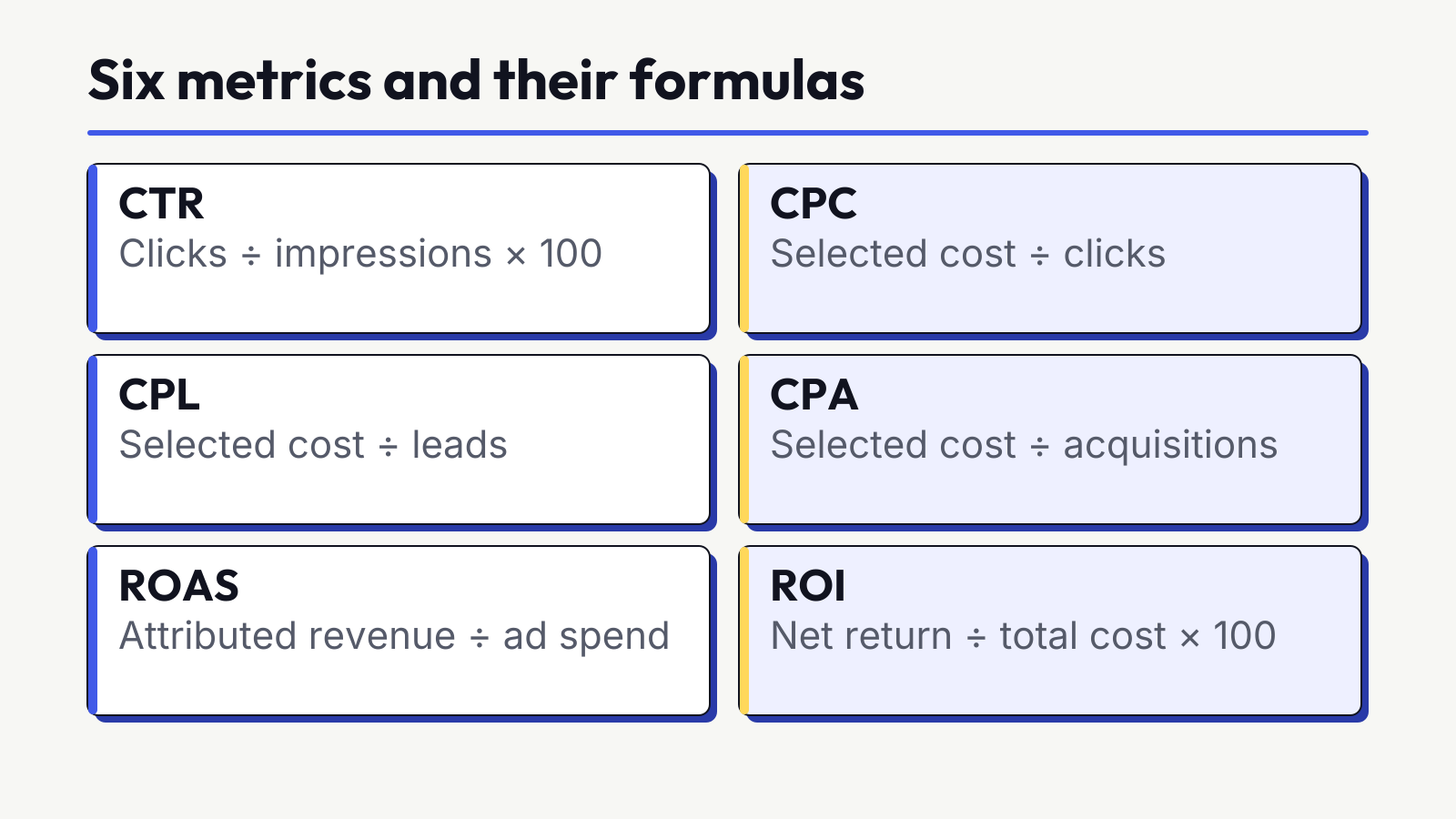
Digital marketing metrics for beginners connect campaign activity to business outcomes. CTR measures clicks from impressions, CPC the average cost of a click, CPL the cost of a lead, CPA the cost of a defined acquisition, ROAS revenue per ad-spend unit, and ROI profit relative to total investment. Each needs a clear denominator, timeframe and attribution rule.
| Metric | Question answered | Formula | Unit | Required inputs | Interpretation limit |
|---|---|---|---|---|---|
| CTR | What share of impressions produced the selected click? | Selected clicks ÷ impressions × 100 | Percentage | Matching click and impression fields | Does not show lead or sales quality |
| Average CPC | What was the average selected ad cost per selected click? | Selected ad spend ÷ selected clicks | Currency per click | Cost and click fields from the same scope | Is not a maximum bid or a value measure |
| CPL | What did each defined lead cost? | Selected cost ÷ leads under one definition | Currency per lead | Cost, lead event and quality rule | Raw and valid leads can produce different answers |
| CPA | What did each defined acquisition action cost? | Selected cost ÷ selected acquisitions | Currency per action | Cost, exact action and counting rule | Does not automatically equal full customer acquisition cost |
| ROAS | How much attributed revenue or value was reported per ad-spend unit? | Attributed revenue or value ÷ ad spend | Multiple or percentage | Revenue/value and ad spend | Is not a profit measure |
| ROI | What profit return was produced relative to the stated investment? | Profit under the declared convention ÷ total stated investment × 100 | Percentage | Revenue, every included cost and attribution basis | Different cost conventions produce different ROI figures |
The table is a starting point, not a benchmark sheet. A “good” result depends on the campaign goal, market, offer, format, data quality and economics. Compare a metric with a relevant target and diagnostic question rather than with a universal number.
How metrics differ from KPIs
A metric is a measured value. A key performance indicator, or KPI, is a metric selected to judge progress towards a specific goal and target. The same number can be a supporting metric in one campaign and a KPI in another.
| Term | Meaning | Illustrative use |
|---|---|---|
| Metric | A recorded campaign value or calculated relationship | CTR is monitored to understand whether selected impressions produce clicks. |
| KPI | A metric tied to an owned goal, target, timeframe and decision | Valid-lead CPL becomes a KPI when the goal is to acquire valid enquiries within an agreed cost range and review period. |
Do not call every dashboard field a KPI. Begin with the business outcome, choose the metric that best represents progress, name the owner and state what action follows if the result is above or below the target. Supporting metrics then help diagnose why the KPI moved.
Start with the goal and timeframe
Before calculating, write a measurement statement that another person can audit. Include:
- Goal: the business outcome the campaign supports.
- Action: the exact click, lead, purchase, booking or other event being counted.
- Numerator and denominator: the two fields used in the formula and their units.
- Period: the start and end dates, with consistent time-zone treatment.
- Scope: platform, account, campaign, channel, geography and device where relevant.
- Data source: advertising platform, analytics, CRM, ecommerce system or finance record.
- Attribution: model, window, counting method and eligible touchpoints.
- Limitation: missing consent, offline actions, duplicate leads, refunds or other known gaps.
Pro Tip
Copy field names exactly from the report. Do not assume that “clicks”, “link clicks” and “outbound clicks” are interchangeable. This is especially important when comparing reports from different platforms or custom dashboards. When you compare Google Ads with Meta Ads, record which campaign and report each field comes from.
Calculate click-through rate
Formula: CTR = selected clicks ÷ impressions × 100.
CTR asks what percentage of the selected impressions produced the selected click. Google’s CTR definition uses clicks divided by impressions. Name the click field because reporting systems can offer different click scopes.
In the fictional campaign used throughout this guide, 600 selected ad clicks came from 20,000 impressions. The calculation is 600 ÷ 20,000 × 100 = 3%. This means 3% of the counted impressions produced the selected click. It does not mean 3% became leads or customers.
Avoid asking whether 3% is universally good. Google notes that a useful CTR comparison depends on what is advertised and the network. A better next question is whether the clicks came from the intended audience and continued to valuable actions.
Calculate average cost per click
Formula: average CPC = selected ad spend ÷ selected clicks.
Average CPC shows the average amount of selected spend associated with each selected click. It is not the same as a maximum CPC bid. Google Ads makes this distinction in its average CPC guidance.
For ₹18,000 ad spend and 600 selected clicks, average CPC is ₹18,000 ÷ 600 = ₹30 per click. The spend and clicks must cover the same campaign scope and period. Combining spend from one range with clicks from another invalidates the result.
A lower CPC is not automatically better. Cheap clicks that are irrelevant or never produce a useful action may be less valuable than more expensive clicks that reach the intended audience. Diagnose query or audience fit, creative, placement, page experience and downstream actions before changing the campaign. For search campaigns, build a query-to-page map to check whether the query and destination solve the same need.
Calculate cost per lead
Formula: CPL = selected cost ÷ leads under the stated definition.
CPL is useful only when “lead” has a stable meaning. A raw form submission may contain duplicates, invalid contact details or enquiries outside the service area. A valid unique lead has passed defined checks. A qualified lead may meet additional business criteria. These denominators should not be mixed.
The fictional campaign received 60 raw lead submissions and 45 valid unique leads. Raw-form CPL is ₹18,000 ÷ 60 = ₹300. Valid-lead CPL is ₹18,000 ÷ 45 = ₹400. Both calculations are correct for their labels. Reporting ₹300 while discussing valid leads would be misleading.
State how duplicates, spam, invalid contact details and attribution were handled. The next diagnostic question is whether the defined leads progressed to the business outcome, not simply whether the CPL fell.
Calculate cost per acquisition
Formula: CPA = selected cost ÷ selected acquisitions or actions.
Always name the acquisition. In a platform report, CPA may mean cost per selected action or conversion, not the full cost to acquire a customer. A purchase CPA, lead CPA and registration CPA answer different questions.
The fictional campaign reported 12 platform-attributed purchases. Purchase CPA is ₹18,000 ÷ 12 = ₹1,500 per attributed purchase. The label preserves both the action and the attribution boundary. It does not say that the platform caused 12 additional purchases.
Check the conversion counting method and window before comparing CPA between reports. Google Ads and analytics reports can differ because they may apply different attribution timing, models, windows and counting settings.
Calculate return on ad spend
Formula: ROAS = attributed conversion revenue or value ÷ ad spend.
For ₹54,000 in attributed purchase revenue and ₹18,000 ad spend, ROAS is ₹54,000 ÷ ₹18,000 = 3x. The same ratio can be displayed as 300%. Write the format so nobody reads 3x as 3%.
ROAS is a revenue-to-ad-spend relationship. It does not subtract product cost, fulfilment, refunds, agency fees, payroll, technology, tax or other operating costs. A 3x ROAS is not automatically profitable. Before interpreting it, check the revenue field, currency, refund treatment, attribution rule and period.
Google’s reporting guidance defines return on ad spend through conversion value relative to cost. That platform efficiency view is useful, but it is narrower than whole-business return.
Calculate return on investment
Worked-example convention: ROI = (revenue minus total stated costs) ÷ total stated costs × 100.
ROI requires a declared profit and investment convention. For this example, total stated costs are ₹18,000 ad spend plus ₹24,000 product and fulfilment costs. Profit under this convention is ₹54,000 revenue minus ₹18,000 minus ₹24,000 = ₹12,000. Total stated investment is ₹42,000.
The calculation is ₹12,000 ÷ ₹42,000 × 100 = 28.6% ROI, rounded to one decimal place. This is not the only valid ROI convention. If agency, payroll, technology, refunds, tax or other costs belong in the decision, include them and relabel the cost base. A correct formula with omitted costs can still mislead.
Do not label revenue divided by spend as ROI. That is ROAS under the stated revenue and ad-spend fields. ROI is intended to express a profit return relative to an investment base, and both must be named.
Compare ROAS and ROI
| Question | ROAS | ROI |
|---|---|---|
| What is the return? | Attributed revenue or conversion value | Profit under the declared convention |
| What is the denominator? | Ad spend | Total stated investment or cost base |
| How is it shown? | Multiple such as 3x, or percentage such as 300% | Percentage such as 28.6% |
| What does it omit by default? | Costs beyond ad spend | Any cost omitted from the declared convention |
| What should be checked? | Revenue field, attribution, refunds, currency and period | Profit basis, complete cost list, attribution and period |
The fictional campaign’s 3x ROAS and 28.6% ROI do not conflict. They use different numerators and denominators. ROAS asks about attributed revenue relative to ad spend. The example ROI asks about profit after stated ad, product and fulfilment costs relative to those stated costs.
Pro Tip
Platform attribution is not incrementality. A platform-attributed purchase is not automatic proof that the ad caused an additional purchase. A causal question needs an appropriate experiment or incrementality method, not only a campaign report.
Follow one campaign from impression to profit
This fictional Ahmedabad direct-to-consumer campaign uses one period and one currency throughout. It records 20,000 impressions, 600 selected ad clicks, ₹18,000 ad spend, 60 raw lead submissions, 45 valid unique leads, 12 platform-attributed purchases, ₹54,000 attributed purchase revenue and ₹24,000 product and fulfilment costs for those purchases.
| Stage | Numerator | Denominator | Calculation | Result | Meaning and limit |
|---|---|---|---|---|---|
| Impression to click | 600 selected clicks | 20,000 impressions | 600 ÷ 20,000 × 100 | 3% CTR | Selected click rate, not conversion rate |
| Spend to click | ₹18,000 spend | 600 selected clicks | ₹18,000 ÷ 600 | ₹30 average CPC | Average, not a bid or value judgement |
| Spend to raw lead | ₹18,000 spend | 60 raw forms | ₹18,000 ÷ 60 | ₹300 raw-form CPL | Valid only for the raw-form definition |
| Spend to valid lead | ₹18,000 spend | 45 valid unique leads | ₹18,000 ÷ 45 | ₹400 valid-lead CPL | Shows how lead quality changes the denominator |
| Spend to purchase | ₹18,000 spend | 12 attributed purchases | ₹18,000 ÷ 12 | ₹1,500 purchase CPA | Platform-attributed action, not full causality |
| Revenue return | ₹54,000 attributed revenue | ₹18,000 ad spend | ₹54,000 ÷ ₹18,000 | 3x or 300% ROAS | Revenue efficiency, not profit |
| Profit return | ₹12,000 profit under stated convention | ₹42,000 stated costs | ₹12,000 ÷ ₹42,000 × 100 | 28.6% ROI | Changes if the cost base changes |
The reconciliation matters. Each funnel metric uses the correct stage as its denominator. If there were zero clicks, leads or acquisitions, the related cost metric would be not calculable for that period. Do not force a zero or infinite result. Report the absence of the denominator and investigate the earlier stage.
When combining campaigns, do not average their CTR, CPC, CPL, CPA or ROAS values without considering weighting. Recalculate the metric from the combined numerators and denominators. A simple average can give a small campaign the same influence as a much larger one.
Avoid common interpretation errors
| Error | Why it misleads | Better question |
|---|---|---|
| Calling one CTR universally good | Network, format, objective, offer and audience differ | Did the selected clicks lead to the intended next action? |
| Choosing the lowest CPC | Cheap clicks may be irrelevant or low quality | What happened after the click? |
| Using raw forms for a qualified-lead claim | The denominator does not match the claim | What validation rule defines the reported lead? |
| Calling every conversion an acquisition | Actions have different business value | Which exact action and counting method produced the CPA? |
| Treating 3x ROAS as 300% ROI | ROAS uses revenue and ad spend; ROI needs profit and a cost base | Which costs and profit definition belong in the decision? |
| Comparing platform totals directly | Attribution, windows, fields and time zones may differ | Can the definitions and scopes be aligned first? |
| Treating attribution as causation | Credit assignment does not prove an additional outcome | Does the question require an experiment or incrementality method? |
Build a beginner measurement sheet
A useful spreadsheet needs enough context to reproduce the decision. Create one row per campaign and period with these fields:
- Goal, primary KPI, target and decision owner
- Platform, account, campaign, objective, market and period
- Spend, impressions and exact click field
- Lead event, raw/valid/qualified rule and duplicate handling
- Acquisition action and counting method
- Attributed revenue, currency, refunds and cost base
- Attribution model, window, time zone and data source
- Actual result, interpretation, limitation and next action
Keep the raw inputs beside the calculated metrics so another person can audit the formulas. If two systems disagree, preserve both values with their definitions instead of silently replacing one. The difference may come from attribution timing, consent, identity, tagging, processing or a genuinely different field.
A beginner does not need to track every available number. Start with the goal and one primary KPI, then add the few supporting metrics needed to diagnose it. For a valid-lead goal, those might be impressions, selected clicks, spend, raw leads, valid leads and the progression to a later action.
Use one campaign to see how every denominator changes the answer.
Frequently asked questions
What is the difference between a marketing metric and a KPI?
A metric is a measured value. It becomes a KPI when it is tied to a specific goal, target, timeframe, owner and decision. Not every dashboard field needs to be a KPI.
How do you calculate CTR?
Divide the selected clicks by the matching impressions and multiply by 100. Name the click and impression fields, platform, campaign scope and period. CTR is a click rate, not a conversion rate.
Is CPL the same as CPA?
No. CPL uses leads under a stated definition. CPA uses a defined acquisition or conversion action. A lead, purchase, booking and registration are different denominators and should be labelled separately.
What is the difference between ROAS and ROI?
ROAS divides attributed revenue or value by ad spend. ROI compares profit under a declared convention with a stated total investment or cost base. ROAS is not a profit measure.
Which digital marketing metrics should a beginner track first?
Start with the business goal and one primary KPI. Add only the supporting funnel metrics needed to diagnose it. Define every field, period, source and attribution rule before comparing results.

Mehul Shah
Mehul Shah is the founder and academic director of Sera Digital Marketing Academy in Ahmedabad. He has more than 11 years of experience in SEO, SaaS marketing and agency work. He writes about SEO, AI search and digital marketing, with a focus on how to audit websites, plan campaigns and measure results.