Key takeaways
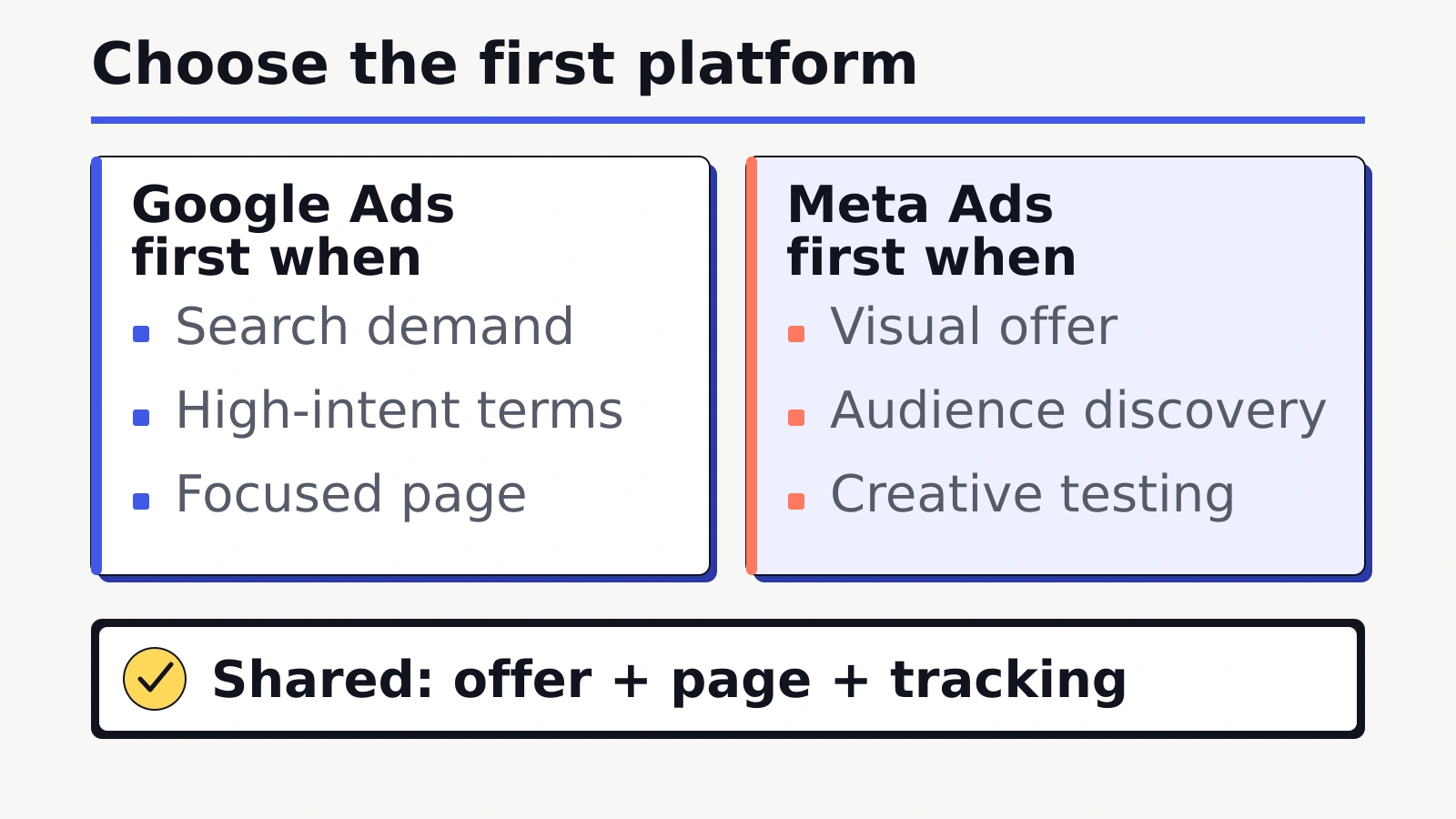
- Learn Google Search Ads first when a project starts with observable search demand and a focused landing page.
- Learn Meta Ads first when the learning task depends on audience hypotheses, visual creative and discovery across social placements.
- Neither platform is universally easier, cheaper or better. The offer, market, objective, creative, destination and measurement setup change the decision.
- Before either platform, define one valuable conversion action and confirm that the landing experience and tracking can support it.
- A beginner usually learns more from one narrow practice brief, a measurement review and a revision than from building two broad campaigns at once.
A person searching Google for a plumber already has a job in mind. Someone who sees a new product in their Instagram feed may have had no plans to look for it. Start with that difference when deciding whether to learn Google Ads or Meta Ads first.
This comparison deliberately focuses on Google Search Ads and a basic Meta campaign workflow. Google Ads includes several other campaign types, and Meta Ads can support awareness, leads and sales across multiple placements. A narrow scope makes the first learning decision practical without pretending that two large advertising systems work in only one way.
Google Ads or Meta Ads: the short answer
Beginners should learn Google Search Ads first when people already search for the product or service and the business can track valuable actions. Learn Meta Ads first when visual creative, audience testing and discovery are central. Both require a clear offer, suitable landing page, realistic budget and reliable conversion tracking.
This is a learning-priority framework, not a promise that one platform will perform better or cost less. If you do not yet have a real project, choose a fictional brief and build a no-spend draft. The first goal is to understand the decisions and evidence, not to launch quickly.
| Decision factor | Google Search Ads | Meta Ads | Beginner check |
|---|---|---|---|
| Customer moment | Often begins with a person expressing a need through a search | Often begins with an audience seeing a message or creative in a social placement | Is demand already visible, or must the message create interest? |
| Starting signal | Search query, keyword and campaign settings | Objective, audience, creative, placement and delivery signals | Which signal can you support with evidence? |
| Creative load | Text assets and landing-page message match are central in Search | Images, video, copy and placement fit usually need more variation | Do you have suitable assets and a testing plan? |
| Destination | A focused page that answers the searched need | A page, form, shop or message destination that continues the creative promise | Does the next step work well on mobile? |
| Measurement | Search terms, ad interactions and configured conversions | Reporting, configured conversions, tests and connected data sources | Can you test the valuable action before launch? |
| Limitation | Search volume does not prove that every query is commercially useful | An audience setting does not guarantee that the message will matter | What evidence would make you pause or change the plan? |
Set the comparison scope
Google Ads is a wider advertising platform, not a synonym for Search. Its campaign types can include Search, Display, Video and other formats, subject to current availability and account eligibility. This article uses Google Search Ads because query, keyword, ad and landing-page alignment gives a beginner a clear learning chain.
Meta Ads covers advertising tools and placements across Facebook, Instagram and Messenger. “Facebook Ads” is sometimes used as older shorthand, but it does not describe the full Meta advertising context. Meta’s official learning catalogue covers Ads Manager, objectives, audiences, placements, creative, budgets, reporting and data sources.
Do not compare an entire platform with one campaign type. A Google video campaign and a Google Search campaign involve different creative and delivery questions. A Meta awareness campaign and a Meta sales campaign should not be judged against unlike objectives. A fair beginner comparison asks what the first project needs and which narrow workflow teaches that need most clearly.
How Google Search Ads capture demand
Google describes Search campaigns as text ads that can reach people while they are searching for products or services. A beginner can trace a straightforward path: a person enters a search term, campaign keywords help determine relevance and eligibility, an ad communicates an offer, a landing page continues the message, and conversion tracking records a valuable action when correctly configured.
A search term is what the person typed. A keyword is what the advertiser adds to an ad group to help target relevant searches. They are related, but not identical. Google’s search terms report guidance explains that advertisers can review significant queries that triggered impressions or clicks. This helps a learner compare planned keywords with actual language and identify irrelevant or unexpected traffic.
Keyword match types affect how closely a keyword must relate to a query before an ad can be considered. They do not remove the need for query review, a relevant offer or a suitable page. The Google auction can also consider bid, ad and landing-page quality, thresholds, competition, search context and expected asset impact. It is therefore unsafe to reduce the learning task to “choose keywords and pay more”.
How Meta Ads create and convert interest
Meta Ads often begins with a business objective, an audience hypothesis and creative that must earn attention in a social environment. The learner chooses a campaign objective, defines where the desired action should happen, prepares appropriate creative and copy, considers placements and connects the ad to a destination or conversion action.
Meta’s official Ads Manager learning covers objectives, audiences, placements, creative, budget, schedule, reporting and advertising standards. This makes Meta a useful first platform when the learning brief depends on visual explanation, audience discovery and creative iteration. It does not mean Meta is only for awareness. The chosen objective and conversion location can also support lead or sales activity when the offer and measurement are ready.
The platform can use automation in audiences and delivery, but automation is not a guaranteed performance improvement. It needs accurate goals, suitable creative and trustworthy data. A beginner should be able to explain the audience hypothesis and the role of each creative variation before relying on automated options.
Compare audience signals and targeting
In Google Search, the query is an immediate signal. Keywords, match types, location, language, audiences and other settings can shape whether an ad is considered. The query still needs interpretation. A search for a broad topic may reflect research rather than a readiness to buy, and a relevant keyword can still lead to an unsuitable landing page.
In Meta Ads, audience selections, platform signals, placement and delivery systems work with the campaign objective and creative. The starting question is less about one typed query and more about who might respond to the message, what evidence supports that audience, and what action the objective is designed to encourage.
Neither system offers perfect knowledge of a person. Treat targeting settings as a hypothesis that must be measured. Avoid sensitive or unsupported assumptions, follow current advertising policies, and document why the selected audience or query group is relevant to the offer.
Compare creative requirements
Google Search teaches concise message alignment. The ad should connect the searcher’s need to a credible offer, and the landing page should continue that promise. The learner needs useful text assets, a clear next action and enough variation to test messages without creating inconsistent claims.
Meta Ads usually places more weight on visual execution and format fit. A learner may need several image or video variations, opening frames that communicate quickly, readable mobile text, platform-appropriate dimensions and copy that works with the creative rather than repeating it. The creative should make sense even when the viewer was not already searching for the offer.
- Define the promise and proof before writing ads.
- Match every asset to the actual destination and offer.
- Create variations that test one meaningful idea at a time.
- Check mobile legibility, accessibility and policy requirements.
- Do not use a visual format merely because it is available.
Compare budgets and learning periods
There is no honest universal answer to which platform is cheaper. Costs and results can change with the auction, audience, geography, objective, creative, competition, bid strategy, offer, landing page and conversion setup. A single cost-per-click figure cannot decide which platform is better for a business.
A beginner should therefore plan the learning test before choosing a spend. Define the single question the test is meant to answer, the valuable action, the risk limit, the review point and the condition for pausing. The budget must be affordable for the business to lose without harming essential operations. When that condition is not met, use a draft account structure, platform walkthrough or fictional brief rather than live spend.
Learning periods also vary. A platform interface can be explored quickly, but sound judgement develops through repeated planning, measurement and revision. Avoid promises such as mastering a platform in a fixed number of days. Progress is better shown through the quality of the campaign rationale and the learner’s ability to diagnose evidence.
Compare landing-page needs
Both platforms can waste a sound campaign idea when the destination is weak. A Google Search landing page should clearly answer the searched need, keep the ad promise and make the next action easy. A Meta destination should continue the message and visual context for someone who may have encountered the offer before actively searching for it. For a search campaign, connect keyword research to a page map before choosing the destination.
| Destination check | Google Search emphasis | Meta Ads emphasis |
|---|---|---|
| Message match | Query, ad and page answer the same need | Creative, copy and page continue the same promise |
| Mobile use | Fast access to the information and action searched for | Clear continuation from a mobile social placement |
| Action | Call, lead, purchase or sign-up is unambiguous | Form, shop, message or page action matches the objective |
| Trust | Accurate details, policy clarity and relevant proof | Consistent identity, offer details and realistic claims |
| Tracking | Configured conversion can be tested | Connected data source and conversion action can be tested |
Do not use the platform choice to avoid fixing the page. If the destination is confusing, switching from one advertising system to another will not resolve the underlying experience.
Compare tracking and attribution
Start with one valuable action: a qualified lead, booking, purchase, sign-up or another outcome that matters to the brief. Google’s conversion tracking guidance explains how configured actions can connect ad interactions with outcomes. Meta’s official catalogue covers Ads Reporting, tests, the Meta Pixel and Conversions API. In both cases, implementation quality and available data affect what can be measured.
Platform-reported numbers are not the whole business record. Compare campaign evidence with form quality, confirmed orders, booking records or other appropriate first-party outcomes. Respect current consent, privacy and sector requirements. If tracking cannot be tested or the business cannot handle follow-up, delay launch.
Pro Tip
Define and test the conversion action before building the campaign. If the thank-you state, call recording, booking confirmation or purchase event cannot be verified, the campaign may teach the wrong lesson from incomplete data. Use the measurement guide to interpret CPL, CPA and ROAS with clear counting and attribution rules.
Choose by business situation
The best first platform is the one that makes the project’s central hypothesis easiest to state and evaluate. Use the scenarios below as decision logic, not as automatic launch recommendations.
| Business situation | Likely first platform | Reason | Evidence needed before launch | Reason to delay |
|---|---|---|---|---|
| Ahmedabad home service responding to “AC repair near me” demand | Google Search Ads | A learner can trace query, keyword, ad, service page and lead action | Relevant searches, service area, working page, call or lead tracking | Unclear coverage, weak follow-up or untested tracking |
| New home-decor brand with strong product photography and little known-brand demand | Meta Ads | The brief depends on audience hypothesis, visual creative and discovery | Clear offer, suitable creative variations, mobile destination and conversion action | Insufficient creative, unclear margins or unreliable order tracking |
| Training provider with a weekend workshop | Either, then sequence the second | Search can address explicit queries; Meta can test audience and creative messages | One shared outcome, accurate offer, landing page and comparable measurement | Unlike objectives make results impossible to compare fairly |
| B2B software demo brief | Google Search first when category or problem queries exist | The learner can map an observable query to a demo path | Query evidence, qualified-demo definition, focused page and follow-up process | Demand is unclear or lead quality cannot be checked |
| Local restaurant opening a new location | Meta first when the immediate task is visual local awareness | Creative and local message delivery are central to the first brief | Accurate location, hours, visual assets and a useful destination | Operational details are not final or the destination is inaccurate |
Ask ten questions before choosing: What outcome matters? Is demand already visible? Does the offer need visual demonstration? Is there a credible audience hypothesis? Does the destination work on mobile? Is the conversion action testable? Is any live budget affordable to risk? Which metric reflects the goal? What policy or consent constraints apply? What evidence would make you stop?
Follow a beginner learning sequence
- Write a one-page brief. Define the audience, problem, offer, valuable action, destination, evidence and constraints.
- Choose one narrow workflow. Use Google Search for a query-led brief or Meta for an audience-and-creative-led brief. Do not build every available campaign type.
- Create the draft structure. Document settings, rationale, ad or creative variations, landing-page match and measurement plan without live spend.
- Run a pre-launch review. Check policy, consent, links, mobile experience, conversion action and follow-up ownership.
- Review evidence and revise. If a supervised live test is appropriate, evaluate the agreed business action as well as platform signals. Change one meaningful variable at a time.
- Add the second platform only with a reason. State the new question it can answer and keep the outcome comparable where possible.
Pro Tip
Keep the first practice brief narrow enough to diagnose. One offer, one meaningful audience or query group, one destination and one valuable action teach more than a broad setup where several variables change at once.
Common comparison mistakes
- Choosing from CPC alone. A lower click cost does not prove that the traffic or outcome is more valuable.
- Choosing the easier interface. Interface comfort is not the same as business fit, and interfaces change.
- Using personal preference as evidence. Platform familiarity can shape execution, but it should not replace customer and project evidence.
- Generalising from one campaign. One result reflects a particular offer, market, creative, setup and period. It cannot settle the platform comparison.
- Comparing unlike objectives. A search lead campaign and a social awareness campaign do not answer the same question.
- Treating Quality Score as an auction score. Google describes Quality Score as a diagnostic, not a KPI and not an auction input.
- Launching before the destination and tracking are ready. Advertising cannot repair an unclear offer or missing measurement.
A careful beginner learns to explain why a platform fits, what must be true for the plan to work, and which evidence could disprove the hypothesis. That reasoning transfers when campaign types, automated features and interfaces evolve.
Choose the first platform from the customer situation and the evidence you can measure.
Frequently asked questions
Which is easier for beginners, Google Ads or Meta Ads?
Neither is universally easier. Google Search may offer a clearer query-to-page learning path, while Meta may suit a learner with strong visual creative and audience hypotheses. Choose the narrower workflow that matches the first project.
Which platform is better for a local business?
It depends on customer behaviour. Google Search may fit a local service with visible search demand. Meta may fit a visual local launch or discovery brief. Accurate location details, a useful destination, tracking and follow-up matter on either platform.
Is Google Ads more expensive than Meta Ads?
There is no universal cost rule. Auction conditions, audience, geography, objective, creative, competition, bid strategy and conversion setup affect results. Compare valuable business actions from a defined test, not a general click-cost claim.
Can beginners learn both platforms at the same time?
They can, but one narrow workflow at a time is easier to diagnose. Build, review and revise a practice brief on the first platform. Add the second when you can explain the new question it will answer.
What should be ready before launching paid ads?
Prepare a clear objective, audience or query rationale, offer, compliant creative or ad assets, mobile destination, affordable risk limit, testable conversion action, consent plan and follow-up process. Delay launch if any critical part is missing.