Key takeaways
- SEO, AEO and GEO overlap because all three depend on accessible pages, useful content, clear entities and credible evidence.
- SEO focuses on organic-search discovery, AEO on answer-oriented experiences and GEO on representation in generative responses.
- Google does not require special AI schema or a separate AI text file for eligibility in AI Overviews or AI Mode.
- Answer and citation visibility can vary by query, prompt, location, language, platform and time, so measurement needs a dated sample.
- Start with technical access, intent, content quality and evidence before creating separate AEO or GEO workstreams.
Search for “how to choose a digital marketing course” and you might see a list of links, a direct answer or a generated summary that cites sources. SEO, AEO and GEO describe ways to make useful information easier to find across those experiences.
What is the difference between SEO, AEO and GEO?
SEO improves how pages are discovered and ranked in search results. AEO makes clear, reliable information easier for answer systems to extract and present. GEO focuses on visibility, citation and representation in generative responses. They overlap heavily because all three depend on accessible pages, useful content, credible evidence and clear entities.
Search engine optimisation, or SEO, improves a site’s ability to be crawled, indexed, understood and usefully presented for relevant organic searches. It combines technical access, content, organisation, internal links and search-result presentation. Google’s Search Essentials and explanation of how Search works are useful primary references.
Answer engine optimisation, or AEO, is used here as a working practitioner label for making accurate answers easy to find, understand and reuse in answer-oriented experiences. It is not a separate Google standard, and clear formatting does not guarantee that a page will appear in an answer feature.
Generative engine optimisation, or GEO, is used here for work intended to improve how source content and named entities are represented in generative responses. The term was formalised in published research in 2024, but platform methods, terminology and measurements remain unsettled. These are operational definitions, not universal technical boundaries.
Why the definitions overlap
A well-researched page does not become three different pages because it may appear on three surfaces. The same page still needs a clear purpose, useful information, accurate facts, technical accessibility and a logical relationship with the rest of the site. The labels change the lens used to review the work, not the need for a sound page. Start by following a beginner keyword research workflow to establish the page’s purpose.
The boundaries also depend on the platform. A short direct answer can support an ordinary search feature, an assistant response or a generated summary. A citation can mean a link in a generated answer, a supporting source, a referenced entity or an ordinary web mention. Use the provider’s exact feature name when reporting results and record what was actually observed.
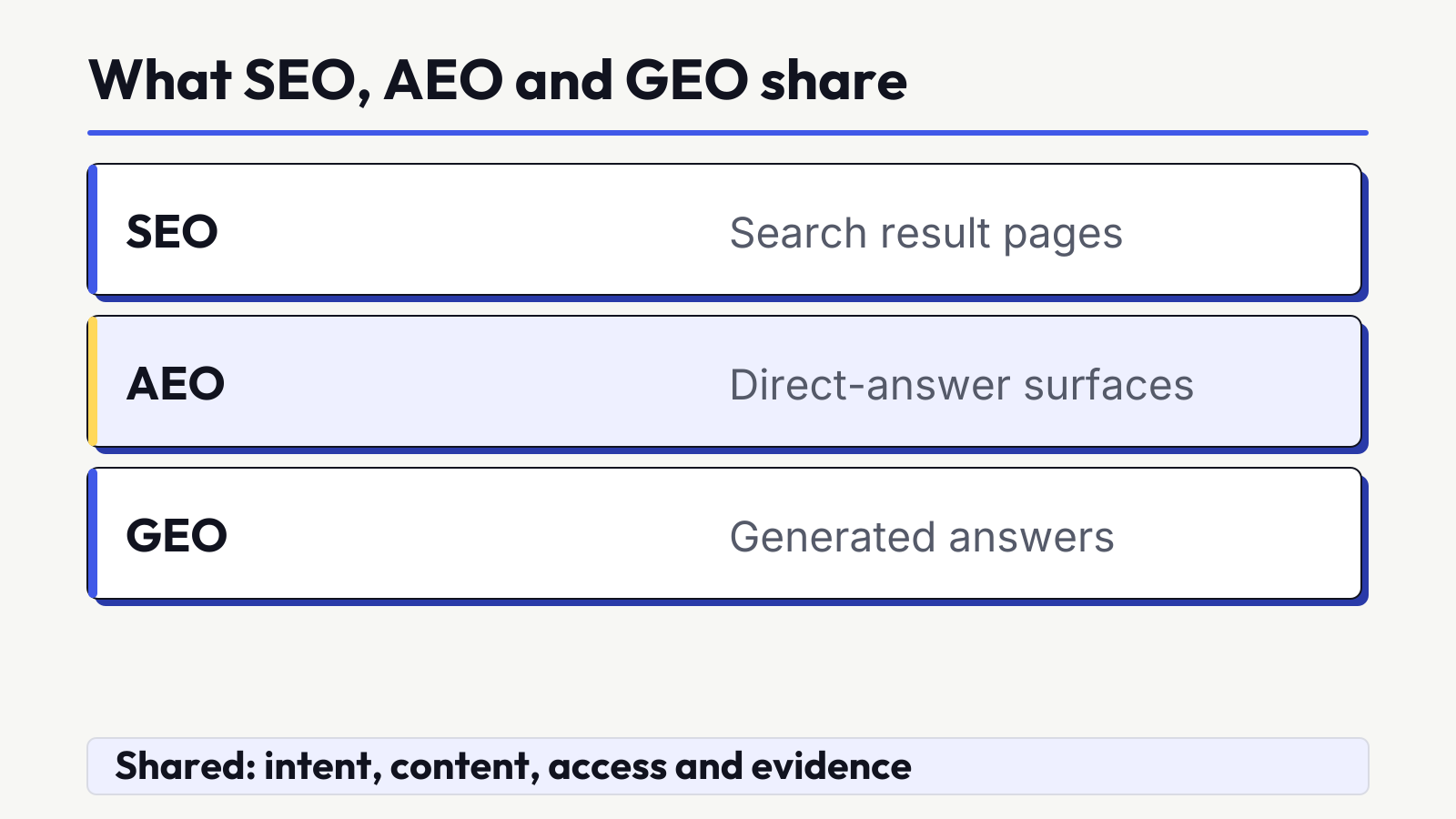
What stays the same across all three
- Technical access: Important pages need to be discoverable, crawlable and indexable where the platform relies on web search.
- Search intent: The page must address a real need with the right format and depth.
- People-first usefulness: Original explanation, practical detail and honest limitations are more durable than text made mainly to manipulate visibility.
- Clear organisation: Descriptive headings, sensible sections, tables where helpful and unambiguous terms make the page easier for people and systems to interpret.
- Entity clarity: Consistent names, relationships, dates and facts reduce ambiguity about the people, organisations and topics discussed.
- Credible evidence: Primary sources, visible support for claims and clear distinction between fact and inference strengthen trust.
- Internal context: Descriptive internal links help users and crawlers understand how pages relate.
- Maintenance: Material claims, screenshots, examples and dates need review as products and search experiences change.
Google states that its existing SEO fundamentals remain relevant to AI Overviews and AI Mode. A page must be indexed and eligible to appear in Search with a snippet before it can be eligible as a supporting link, but eligibility does not guarantee inclusion. The official AI features guidance also says no special optimisation or AI-specific schema is required.
Pro Tip
Before adding an AEO or GEO task, write the page’s audience, question, owner entity, evidence and current indexing status. If these are unclear, the foundation needs attention first.
Where SEO, AEO and GEO differ
| Work area | SEO emphasis | AEO emphasis | GEO emphasis |
|---|---|---|---|
| Discovery | Crawlability, indexing, relevance and result presentation | Question coverage and self-contained answers | How sources and entities are retrieved and represented in generated responses |
| Content structure | Logical pages that satisfy intent and support useful snippets | Precise wording, answer-first passages and clear definitions | Evidence-rich passages, consistent entities and source context |
| Off-page review | Relevant links, mentions and broader site reputation | Whether answers are corroborated and understandable | Where the entity and its claims appear across independent sources |
| Testing | Queries, pages, rankings, clicks and conversions over time | Observed answer inclusion for a defined question set | Prompt samples, provider citations, mentions and representation accuracy |
| Main uncertainty | Results vary by query, location, device and time | Answer features are selective and can change | Provider behaviour and reporting are incomplete and volatile |
Compare goals, surfaces and measures
| Term | Primary goal | Typical surface | Useful measures | Measurement limit |
|---|---|---|---|---|
| SEO | Improve relevant organic discovery and page usefulness | Organic listings and supported Search features | Indexing, query impressions, clicks, position context and outcomes | No metric proves causation by one change |
| AEO | Make accurate answers easy to understand and reuse | Direct-answer, assistant and answer-oriented experiences | Answer presence, source link, answer accuracy and downstream visits where observable | Feature appearance is not guaranteed or completely reported |
| GEO | Improve accurate source and entity representation | Generative answers across named providers | Citation, mention, link, representation accuracy and referral sessions | Results can vary between prompts, runs and user contexts |
Follow one example across all three
Consider a fictional page answering “How should a small Indian retailer choose an email platform?” The page compares needs, explains evaluation criteria and cites current primary documentation. It does not claim that one platform is universally best.
- SEO lens: Can search systems discover and index the page? Does it match the comparison intent? Are the title, main heading, sections and internal links clear?
- AEO lens: Can a reader quickly find a direct answer and the criteria behind it? Are definitions and trade-offs self-contained rather than vague?
- GEO lens: Are the retailer scenario, products, dates and sources unambiguous? Does the page distinguish observed facts from the author’s recommendation?
The same research and page support all three lenses. The additional work is mainly in checking answer extractability, evidence visibility, entity consistency and how different systems represent the page. Creating three repetitive versions would risk confusing both users and page ownership. Use current SERP examples to recognise mixed search intent before deciding whether another page is needed.
Use one search visibility workflow
- Define the need: Record the audience, query or prompt family, page purpose and intended action.
- Check access: Confirm the canonical page, indexing conditions, rendered content and snippet eligibility.
- Study the surface: Observe current search results and answer experiences for a dated, localised sample.
- Improve the page: Add a direct answer, supporting detail, clear entities, primary evidence and honest limits where they help the reader.
- Check site relationships: Use descriptive internal links and avoid duplicate pages for the same need.
- Verify claims: Confirm dates, product facts, definitions and source relevance before publication.
- Record a baseline: Save query, provider, locale, date, surface and what was visible.
- Review carefully: Compare later observations without claiming that one edit caused every change.
Choose what to do first
| Current problem | First priority | Why |
|---|---|---|
| Important pages are not indexed | Technical SEO and content accessibility | Answer-focused formatting cannot compensate for an unavailable page |
| Pages rank but answer the question vaguely | Clarify intent, direct answers and supporting evidence | The page needs to become more useful before chasing a new label |
| Brand facts differ across owned pages | Entity and fact consistency | Conflicting names, claims and dates create ambiguity |
| Search performance is known but answer visibility is not | Create a small dated observation set | A baseline is needed before changes can be reviewed |
| A small team has limited capacity | Improve the highest-value existing page | One strong owner page is more manageable than separate SEO, AEO and GEO versions |
Measure without false certainty
For SEO, Search Console can show web-search impressions, clicks, queries and pages, but it does not prove why a change occurred. Google says traffic from its AI features is included within the Web search reporting rather than provided as a separate AI-feature report.
For AEO and GEO, create a repeatable observation sheet. Record the exact query or prompt, provider, feature, date, locale, sign-in state where relevant, source links, brand mentions and factual accuracy. Repeat the same sample periodically. Do not present a single run as permanent visibility or a complete measurement of the platform.
- Separate inclusion from prominence and accuracy.
- Separate a link from an unlinked mention.
- Record whether the referenced passage actually supports the generated claim.
- Keep prompt wording and locale consistent during comparisons.
- State that results can vary between runs and users.
Common claims to avoid
- “GEO replaces SEO.” Generative visibility still depends heavily on useful, accessible and credible source content.
- “Special AI schema is required.” Google says no special schema is needed for AI Overviews or AI Mode.
- “An llms.txt file guarantees citation.” Do not present an unsupported file convention as a visibility requirement.
- “Short answer blocks force inclusion.” Clear answers can help readers and extractability, but they do not control platform selection.
- “Every mention is a ranking factor.” Record mentions and citations as observations without inventing one universal algorithm.
- “A generated answer is always correct.” Important information should be checked against relevant sources.
Pro Tip
Use structured data only when it matches visible content and a supported type. Correct markup can establish eligibility for a feature, but it does not guarantee display or generative citation.
In SERA’s beginner programme, learners compare SEO, AEO and GEO, review entities, mentions, citations and answer surfaces, then create an evidence-based visibility review and prioritised action plan. The work is designed to build careful observation and decision-making, not to promise a ranking or citation outcome.
Start with one workflow before adding new labels.
Frequently asked questions
Are AEO and GEO the same thing?
Not exactly, although the terms overlap. AEO usually emphasises clear answers in answer-oriented experiences. GEO usually emphasises source and entity representation in generative responses. Neither has one universally accepted boundary.
Does GEO replace SEO?
No. Strong technical access, useful content, intent alignment and evidence remain relevant. GEO adds a generative-answer review lens rather than removing the need for SEO foundations.
Which should a beginner learn first?
Start with SEO foundations: crawling, indexing, intent, content quality, site structure, internal links and measurement. Then apply AEO and GEO lenses to the same pages and evidence.
Do AI answers require special schema or an llms.txt file?
Google says no special schema is required for its AI features. Use supported structured data that matches visible content. Do not treat an llms.txt file as a guaranteed citation requirement.
How can you measure AEO and GEO visibility?
Use a dated, repeatable sample of queries or prompts. Record the provider, locale, surface, citations, mentions, links and accuracy. Report volatility and incomplete platform data rather than promising complete measurement.
Research date: 1 November 2026. Search and generative-answer features change over time. Verify current provider documentation and record the observed surface before drawing conclusions.

Mehul Shah
Mehul Shah is the founder and academic director of Sera Digital Marketing Academy in Ahmedabad. He has more than 11 years of experience in SEO, SaaS marketing and agency work. He writes about SEO, AI search and digital marketing, with a focus on how to audit websites, plan campaigns and measure results.