
Key takeaways
- Search intent describes the task behind a query, not merely the words typed into a search box.
- Informational, commercial investigation, transactional and navigational are useful editorial labels, but they are not permanent Google-assigned keyword categories.
- Result types, repeated page formats, local features and the mix of official, product or explanatory pages provide stronger evidence than a modifier alone.
- A query can have a dominant intent and a secondary intent, and the balance can change by location, language, device and time.
- The practical decision is to match the observed need with a suitable page purpose, format and next action, then recheck important queries before publishing.
Search “how to set up Google Ads” and then “Google Ads agency Ahmedabad”. The first search asks for instructions. The second is more likely to lead to providers. These search intent examples show how the words and the results help you decide what kind of page to create.
The goal is not to attach a label and stop. A useful intent analysis should lead to a decision: should the searcher receive an explanation, a comparison, a product or category page, a service page, a location page, a tool, or an official destination? The worked examples below show how to move from query to evidence to page choice while recording uncertainty honestly.
What does search intent mean?
Search intent is the likely task behind a query. Informational searches seek an explanation, commercial-investigation searches compare options, transactional searches support an action, and navigational searches seek a specific site or page. Local intent can overlap with any of them. Classify intent from the current results, not only from the words in the query.
These four labels are a practical editorial convention. They help content teams discuss what a page needs to do, but they are not Google’s published ranking categories. Google’s Search Quality Rater Guidelines describe Know, Do, Website and Visit-in-person needs. Commercial investigation is usually a more specific editorial label for a person who is learning and comparing before a later action. Local searches often map to Visit-in-person, while also carrying a Know or Do need.
The distinction matters because quality raters do not directly rank an individual page. Google explains that their feedback helps evaluate whether proposed search changes produce useful results. Treat the guidelines as a framework for understanding needs, not as a formula for rankings. The safer editorial question is simple: what useful task should this page help a person complete?
Why query wording is not enough
Modifiers are clues. They are not verdicts. The word how often points towards an explanation, vs often suggests comparison, login usually indicates a destination, and near me brings location into the decision. Yet each modifier can appear in a query with more than one plausible need.
Consider passport renewal. One person may need to understand the documents and rules. Another may be ready to start an application. A useful result page may therefore contain official guidance, a direct application destination, questions and explanatory media. Calling the query purely informational would ignore the action. Calling it purely transactional would ignore the preparation. A better record is “dominant Know and Do needs, with an official destination required”.
Exact words are not the whole relevance test either. Google’s explanation of how results relate to a search notes that useful results may use related terms and other signals. This is another reason to inspect page purpose and result format rather than counting matching words.
Pro Tip
Write two possible needs before checking the SERP. This small pause reduces the chance that your first guess will control what you notice. Then record which result patterns support or weaken each interpretation.
Four search-intent types
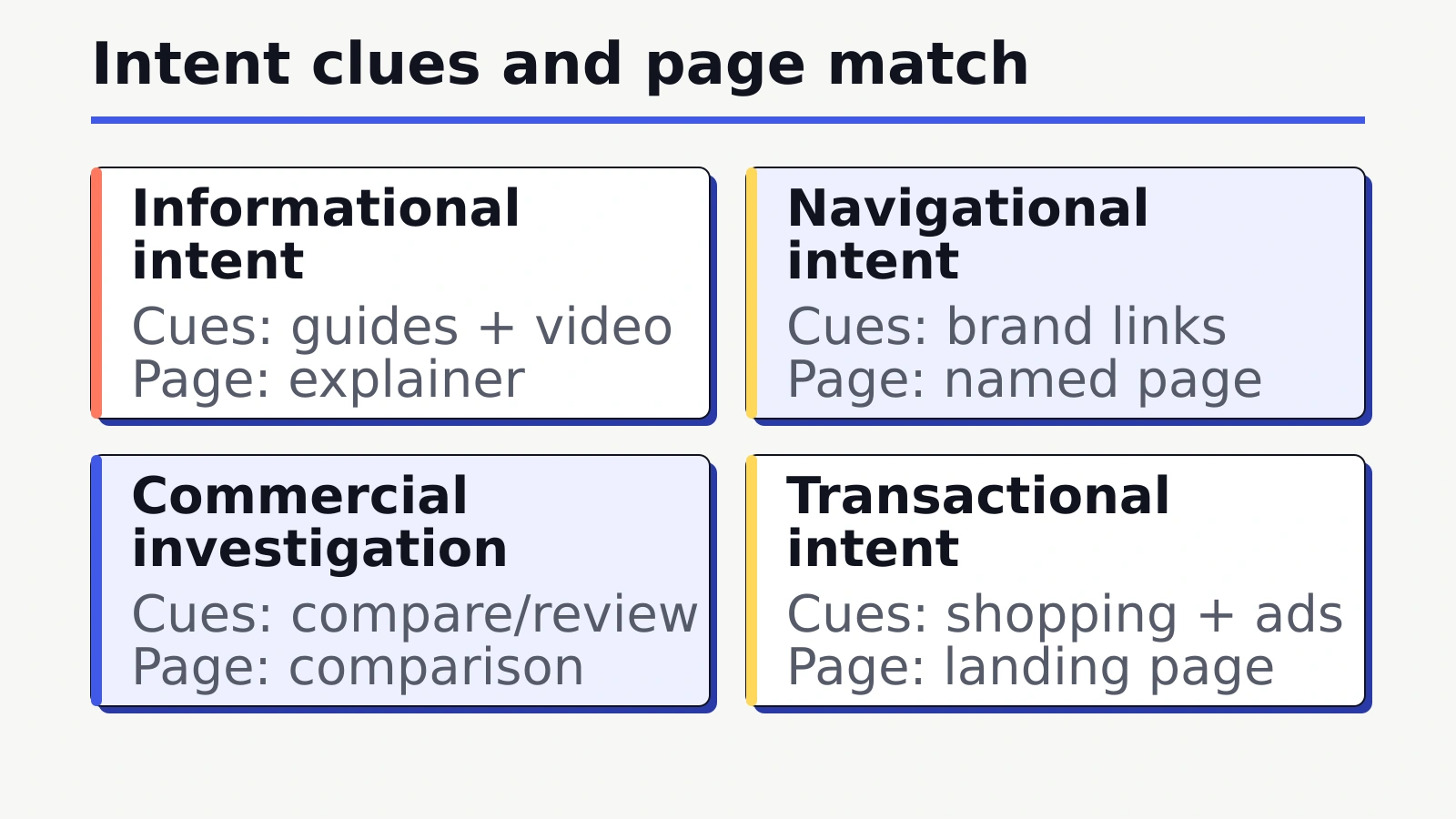
The four-type model is most useful when each label includes a likely task, visible evidence and a suitable page response. The table uses neutral examples, not rigid rules.
| Intent | Likely task | Common query clues | SERP patterns to inspect | Suitable page formats | Caution |
|---|---|---|---|---|---|
| Informational | Learn, understand or get an answer | How, why, meaning, guide, symptoms | Explanatory articles, official guidance, videos, definitions, questions | Guide, tutorial, glossary, reference page | A question can still lead to a later action. |
| Commercial investigation | Compare options or decision criteria before acting | Best, vs, review, alternatives, price comparison | Comparisons, category pages, product grids, reviews, decision guides | Comparison, category page, buying guide | This is an editorial subclass, not an official Google category. |
| Transactional | Buy, book, apply, download or sign up | Buy, book, apply, order, download | Product or service pages, forms, official action pages, shopping units | Product, service, booking, application or download page | People may still need reassurance or instructions. |
| Navigational | Reach a specific site, page, account or portal | Brand, login, app, official site, contact | Official homepage, login page, sitelinks, help destination | Official destination page | A third-party article is rarely the best answer to a direct destination need. |
How local intent changes the SERP
Local intent is not simply a fifth box beside the other four. It is a geographic layer that can combine with learning, comparison or action. AC repair cost may invite an explanation and a comparison. AC service near me adds a strong location need. Book AC service makes the action more prominent. The same topic can therefore require different pages and calls to action.
Look for maps, location panels, nearby business listings, opening hours, directions and location pages. Also check whether official national guidance remains visible. A query such as Aadhaar Seva Kendra near me can combine an official information need with a visit-in-person task. A useful analysis would record the local feature, the official locator, the location context and the need to verify operational details rather than copying them into a static article.
Google states that relevance can depend on signals including location, language and device. This means your result page in Ahmedabad may differ from a colleague’s result page elsewhere. Record the city or country used for the check, whether location access was available, the device, language and date. Do not present a local result pattern as universal.
How mixed intent appears in results
Mixed intent appears when the result page repeatedly supports more than one credible task. The evidence might be a blend of guides and product pages, an official destination beside explanatory articles, or a local pack alongside comparison pages. One unusual result is not enough. Look for a pattern across the page. The differences between SEO, AEO and GEO offer another reason to separate a user’s task from the surface presenting the answer.
Record a dominant intent when one need clearly shapes most results. Add a secondary intent when another need is substantial enough to affect the page. For laptop vs tablet for students, comparison is likely dominant, while a later purchase is secondary. A comparison guide can serve the first task and link people towards suitable categories without pretending everyone is ready to buy.
A single page can serve an overlap when the same reader moves through the needs in one coherent journey. For example, an explanation followed by a short decision table may satisfy learning and comparison. Separate owner pages are safer when the purposes conflict, such as a broad guide and a specific product or location page. Combining them can create an unfocused page that answers neither need well.
Informational intent example
Use the real query how does UPI work. Before labelling it, inspect whether the result page prioritises definitions, official guidance, explanatory articles, videos or common questions. Those formats support a Know need because they help a person understand the system rather than complete a particular payment inside the search result.
- Observation to record: the proportion of explanatory and official pages, plus any videos or answer formats.
- Likely classification: informational, with high confidence only if explanation-led results dominate.
- Page decision: an answer-first guide with a simple process explanation, supported by an official source for operational facts.
- Limitation: a related query about making a specific payment could carry a different Do need.
The lesson is not that every “how” query needs a long article. If a concise official answer satisfies the task, extra length will not make a page more useful. The appropriate depth follows the complexity of the question.
Commercial investigation example
Now use laptop vs tablet for students. Inspect whether the SERP contains comparison guides, product grids, videos, forums and recurring criteria such as portability, software, note-taking, battery life and budget. The repeated criteria are evidence that the person needs help making a choice, not merely a definition of each device.
- Observation to record: comparison formats, product-led results and the decision factors repeated across them.
- Likely classification: commercial investigation, with a secondary transactional possibility.
- Page decision: a balanced comparison organised around student tasks, constraints and trade-offs.
- Limitation: commercial investigation is an editorial label, and the searcher may not plan to buy immediately.
A useful comparison should help the reader eliminate unsuitable options. It should not turn into a list of products simply because product results are present. The content format must follow the dominant task, while a restrained next step can support readers who are ready to act.
Transactional intent example
For apply for passport online India, look for the official Passport Seva destination, process guidance, eligibility information and supporting questions. The verb apply is a strong action clue, but the SERP may still provide information because a person needs to prepare before submitting an application.
- Observation to record: whether an official action page is prominent and whether guidance pages support the action.
- Likely classification: transactional or Do intent with informational support.
- Page decision: the official application destination should own the action. A guide should clarify preparation and direct the reader safely rather than imitate the service.
- Limitation: process requirements can change, so a third-party guide needs a visible review date and current official citations.
This example also shows why source authority is part of intent satisfaction. For government applications, reaching the correct official destination is more important than keeping a visitor on an editorial site.
Navigational intent example
For GST portal login, inspect whether the official portal and its login or help destinations dominate. The brand-like entity and login modifier suggest a Website need, but the result pattern confirms whether people are primarily trying to reach a destination rather than read an article about it.
- Observation to record: official destination, sitelinks, login and help pages.
- Likely classification: navigational, with a possible support need.
- Page decision: the official destination is the best match. An independent page should not compete with it for a direct login task.
- Limitation: people must verify the domain before entering credentials, and result layouts can vary.
A navigational query is a useful reminder that not every keyword deserves a new article. Sometimes the correct content decision is not to create a page at all. Follow the complete workflow to turn keyword research into a page map and record that decision.
Compare local, ecommerce and SaaS SERPs
The same observation fields can be used across very different sectors. What changes is the evidence and the page that can satisfy the need.
| Context | Neutral query | Useful SERP evidence | Likely need | Possible page match |
|---|---|---|---|---|
| Local service | AC service near me | Map results, service pages, location details, opening hours, calls or booking actions | Local plus transactional, with comparison possible | Accurate location or service page |
| Ecommerce | running shoes for flat feet | Category pages, product results, buying guides, filters and recurring fit criteria | Commercial investigation with possible purchase | Useful category page supported by guidance |
| SaaS | project management software comparison | Comparison pages, feature tables, product pages, review formats and demo actions | Commercial investigation | Comparison or alternatives page supported by examples or data |
Do not assume that one feature settles the classification. A map suggests local relevance, but the query may still be exploratory. A product grid suggests shopping behaviour, but the user may need education first. A demo button signals an action, but the dominant need may remain comparison. Use the whole pattern.
Classify intent from the live SERP
A repeatable check prevents intuition from becoming an unsupported label. Use these five steps:
- Define the viewing context. Record market, language, device, location setting, personalisation state and date. Use the context that matches the intended audience.
- Inspect result types and features. Note guides, comparisons, product or category pages, official portals, maps, images, videos, forums and answer surfaces. Record ads separately from organic formats.
- Identify repeated page formats. Look at what most prominent organic results are built to do. A repeated format is stronger evidence than one outlier.
- Mark dominant, secondary and local needs. Explain which observations support each label. Add a confidence level such as high, medium or low.
- Make and date the page decision. Choose create, improve, consolidate or do not create. State the page format and the reason, then set a recheck date for volatile queries.
Pro Tip
Save an evidence row, not just a screenshot: query, date, locale, device, dominant result types, repeated formats, primary intent, secondary intent, page decision and confidence. A screenshot becomes stale quickly; a structured note explains the reasoning.
Google’s documentation on how Search works explains that result relevance can reflect the query and context. This supports recording conditions, but it does not make any third-party intent label definitive. The final classification remains a documented editorial inference.
Match intent to the right page format
Intent analysis becomes useful when it changes what you build. Map the observed need to the smallest page format capable of satisfying it.
| Observed need | Page format | What the page should prioritise | When not to use it |
|---|---|---|---|
| Understand a concept | Editorial guide or reference page | Direct answer, explanation, examples and verified sources | When the result set is dominated by a simple official answer |
| Compare options | Comparison or buying guide | Decision criteria, trade-offs, evidence and suitable next steps | When the query is clearly for one known product or destination |
| Browse a product family | Category page | Clear grouping, filters, useful descriptions and paths to products | When the need is mainly educational |
| Evaluate one offering | Product or service page | Fit, specifications or scope, proof, limitations and action | When the query compares several alternatives |
| Find a nearby provider | Location page | Accurate area, contact, hours, service and directions | When no genuine local presence exists |
| Complete a repeatable task | Tool or template | Usable input, output, instructions and privacy clarity | When the task only needs explanation |
| Reach a named destination | Official page | Fast, safe access to the requested destination | On an unrelated third-party site |
The title, section order and CTA should follow the same decision. An informational guide may lead to a checklist or related explanation. A comparison page may lead to a category. A transactional service page may lead to a form. A mismatch, such as an aggressive booking CTA on a basic definition query, can make the page feel premature even if the topic is relevant.
Common search-intent mistakes
- Classifying from a modifier alone. Use modifiers to form a hypothesis, then inspect the live results.
- Copying the most common format without understanding the task. Repeated formats are evidence, not a guarantee that imitation will perform.
- Treating a tool label as ground truth. A third-party label is an estimate. Keep your observations and rationale.
- Ignoring mixed and local needs. Add primary, secondary and location notes instead of forcing one box.
- Using the quality-rater framework as a ranking recipe. It helps explain needs, but rater scores do not directly control an individual page’s position.
- Creating a page for every variation. Closely related queries may belong to one owner page when they share intent and format.
- Keeping an old classification forever. Recheck results after product changes, major events or shifts in local and seasonal demand.
Google’s guidance on helpful, people-first content offers a useful final check: does the page leave its intended audience feeling that they learned enough to achieve their goal? That question is more valuable than trying to reproduce every visible SERP feature.
Use the live results to classify the need before choosing a page format.
Frequently asked questions
What are the main types of search intent?
Four common editorial labels are informational, commercial investigation, transactional and navigational. Local intent can overlap with them. Google quality-rater guidance uses the related Know, Do, Website and Visit-in-person needs, so do not present the four editorial labels as official ranking categories.
Can one query have mixed intent?
Yes. Record a dominant and secondary need when the live results repeatedly support both. Note the locale, device and observation date, then decide whether one coherent page can serve the overlap or separate pages need different owners.
How do you identify search intent from a SERP?
Record the result types, features and repeated page formats, then infer the task those pages satisfy. Compare the pattern with the query wording, mark confidence and date the decision. One modifier or one unusual result is not enough.
Is local intent a separate search-intent type?
It is often more useful to treat local intent as a geographic layer. A local query can also be informational, comparative or transactional. Record visible local features and the search location because results can vary by place and device.
Can search intent change over time?
Yes. Events, products, seasons and changing user behaviour can alter the dominant interpretation and result mix. Date every important analysis and recheck volatile queries before publishing or making a major page decision.