
Key takeaways
- Placement assistance describes defined support services. It does not by itself promise an interview, offer or job.
- A placement guarantee is meaningful only when the exact outcome, eligibility rules, deadline, exclusions and remedy are written clearly.
- Application access, an interview, an offer, joining and retention are different stages and should never be counted as the same outcome.
- Any placement percentage needs a named cohort, numerator, denominator, reporting period, role definition and verification method.
- The employer controls the hiring decision, so learners should assess the provider’s written commitment without treating support as employment certainty.
Before you pay for a course that promises placement assistance or a placement guarantee, ask to see the promise in writing. Find out what the institute will do and who makes the final hiring decision.
This guide is educational, not legal advice. A material financial commitment or disputed guarantee may require independent advice based on the actual contract and facts. The practical aim here is to help you turn a headline into verifiable questions before you pay.
What is the difference between assistance and a guarantee?
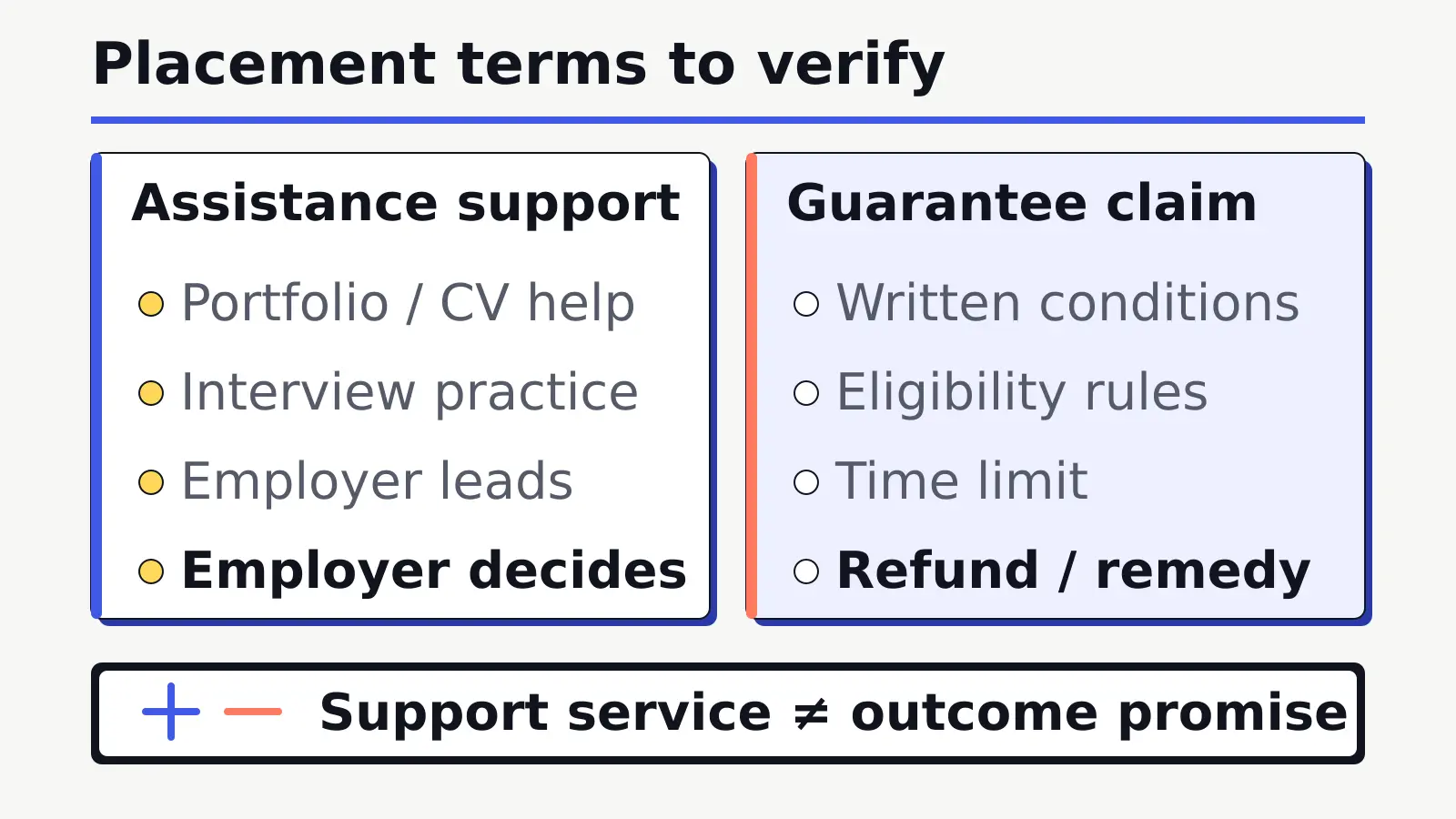
Placement assistance vs placement guarantee describes two different commitments. Assistance usually means defined career-support services such as resume review, interview practice or opportunity sharing. A guarantee is a documented outcome-related promise with eligibility, timeframe, exclusions and remedy. Never rely on the label alone. Ask for the current written policy, evidence and who controls the final hiring decision.
There is no single official definition that makes every provider’s “placement assistance” package identical. Treat it as a service label whose useful scope comes from the written list of activities, frequency, duration and learner responsibilities. Official services such as the National Career Service show that career support can cover distinct activities such as job search, matching, counselling and job-fair information. A private course must still state which activities it actually offers.
| Label | What may be promised | What is not proved | Written terms to request | Main decision risk |
|---|---|---|---|---|
| Placement assistance | A defined set of preparation, guidance or opportunity-access services | An interview, offer, joining or retained job | Services, frequency, eligibility, duration, learner duties and exclusions | Assuming an undefined label includes more than it does |
| Placement guarantee | A stated outcome under defined conditions | That every learner qualifies or that the outcome is unconditional | Exact outcome, deadline, eligibility, exclusions, placement definition and remedy | Treating a conditional or unsupported promise as certain employment |
What placement assistance may include
Depending on the written policy, assistance may include resume or portfolio review, interview practice, job-search guidance, opportunity alerts, employer introductions or application support. These are examples, not a standard package. One provider may offer a single group session, while another may define several review rounds and a time-limited opportunity-sharing process. Learners can also build a portfolio without work experience to prepare evidence they control.
| Possible service | Evidence to request | Limitation to record |
|---|---|---|
| Resume or portfolio review | Number of reviews, reviewer role, format and sample rubric | Review does not guarantee employer acceptance |
| Interview practice | Individual or group format, number of sessions and feedback method | Practice is not a promised interview |
| Opportunity sharing | Channel, frequency, role or location limits and support period | A shared opening is not an application or interview |
| Employer introduction | What “introduction” means and who submits the application | An introduction does not transfer hiring control from the employer |
| Application guidance | Eligibility, learner duties, documentation and follow-up process | The learner still needs to apply and perform through selection |
If a brochure says only “placement assistance included”, ask who provides each service, how often, for how long after completion and what the learner must do to remain eligible. Written answers define the scope. The label does not. Use the questions to ask during a demo class to turn these service descriptions into checks you can record.
What a placement guarantee must define
A guarantee claim should be read as a complete promise stack, not as one bold word. The stack includes the label, exact commitment, eligibility, counting rule, deadline, exclusions, remedy and proof. If one element is missing, you cannot tell what the promise means in practice.
- Outcome: Is the commitment an application, interview, offer, joining, retained job or refund?
- Eligibility: Which attendance, assignment, assessment, application or conduct conditions apply?
- Role definition: Must the work relate to the course, and are internships, contracts or freelance projects included?
- Location and work mode: Are city, relocation, shift, remote work or travel conditions specified?
- Timeframe: When does the period start and end?
- Exclusions: Which learner decisions or external events remove eligibility?
- Remedy: What happens if no qualifying outcome occurs by the deadline?
A guarantee is not automatically unlawful merely because the word appears. The concern is whether a claim is false, misleading, unsubstantiated or materially incomplete. The Consumer Protection Act, 2019 includes false guarantees and deliberate concealment of important information in its definition of misleading advertisement.
Also separate a placement guarantee from adjacent payment or access models. An interview commitment promises a selection opportunity, not employment. A conditional refund describes a remedy if stated conditions are met. A pay-after-placement plan describes when or how fees become payable. None of these labels has a complete meaning until the written document defines placement, eligibility, deadline, cost and consequence.
For example, a “refund if not placed” statement could apply only to learners who complete every assignment, attend every interview, apply to a minimum number of roles and accept work in specified locations. The right question is not whether the headline sounds strong. It is whether the complete conditions are visible, consistent and workable before enrolment.
Read eligibility conditions and exclusions
Eligibility can determine whether a guarantee applies at all. Read the current policy version before enrolment and keep a copy. Check attendance, assessment, assignment, application, interview and document requirements. Ask whether refusing a role, location, shift, compensation range or work mode affects eligibility.
Do not accept a condition that exists only in a later email or is explained verbally after payment. The headline, counselling explanation, admission document and policy should be consistent. Request the version date, the batch or course covered and the person responsible for answering policy questions.
Pro Tip
Rewrite every condition as a yes-or-no check. For example: “Does missing one assessment remove eligibility?” and “Does declining a night-shift role end the guarantee?” Precise questions expose gaps that broad wording can hide.
Ask what outcome is actually promised
Placement is not one event. It is a sequence, and each stage needs a separate definition:
- Opportunity lead: a vacancy or employer need is shared.
- Profile forwarded: an application or profile reaches an employer.
- Interview: the employer invites the applicant to a selection stage.
- Offer: a written employment proposal is issued.
- Joining: the learner accepts and begins the role.
- Retention: the learner remains employed for a defined period.
A provider may influence preparation and introductions, while the learner controls applications and performance and the employer controls selection. Ask where the written commitment stops. If a policy counts an interview as a placement, that is materially different from a job offer or joining.
Verify placement data and evidence
A percentage without a denominator is not useful evidence. If a provider publishes a placement rate, request enough information to reconstruct what was counted without asking for identifiable learner records.
| Evidence field | Question to ask | Why it matters |
|---|---|---|
| Cohort and period | Which course, batch dates and reporting date does the claim cover? | Prevents old or unrelated outcomes from being presented as current |
| Denominator | Is the base enrolled learners, eligible learners or job-seeking learners? | Different bases produce different percentages |
| Numerator | Are interviews, offers, joining or retained roles counted? | Separates access from employment outcomes |
| Eligibility | How many enrolled learners were excluded and why? | Shows whether the headline covers the full cohort |
| Role relevance | Must the role relate to the training? | Clarifies what “placed” means |
| Verification | Who checked the records and when? | Distinguishes internal claims from independently reviewed evidence |
| Remedy | What written process applies if the stated promise is not met? | Connects the claim to a practical consequence |
Do not request public appointment letters, contactable-student lists or personal salary documents. Ask for aggregated cohort definitions, an anonymised verification method and the policy used to count outcomes. Privacy-respecting evidence can still be specific.
Separate interview access from employment
Consider a learner who receives three interview opportunities but no offer. The provider may have delivered a clearly defined interview-access commitment, yet the learner was not employed. Describing that result as “placed” would blur two different outcomes.
Likewise, a job alert is not an application, and a profile forwarded to an employer is not an interview. Ask the provider to name the exact unit it counts. If the policy uses several stages, request separate totals for leads, applications, interviews, offers and joining.
Check who controls the hiring decision
| Party | What they may control | What to verify |
|---|---|---|
| Training provider | Teaching, defined support, introductions and policy administration | Exact service scope, records, eligibility and remedy |
| Learner | Attendance, assignments, applications, interview preparation and acceptance decisions | Every duty that affects eligibility |
| Employer | Shortlisting, interviews, offer terms and final hiring decision | Whether the provider accurately describes its influence |
| External conditions | Market demand, location, timing and role availability | Exclusions and changes that affect the commitment |
A course can help a learner build reviewable work, improve after feedback and prepare to explain decisions. Those learning outputs may support an application, but they do not transfer hiring control from the employer or guarantee employment.
Review refund and remedy terms
If a guarantee mentions a refund or another remedy, ask for the calculation, deadline, claim process, required documents and decision-maker. A phrase such as “money back” is incomplete unless it states whether the refund covers tuition, taxes, tools, registration charges or only a portion of the fee.
Check whether the remedy applies automatically or requires a claim. Record when the learner must notify the provider, how the provider responds, whether there is an appeal or complaint process and which exclusions apply. Do not assume a remedy from the advertisement if the written policy is silent.
Spot misleading placement claims
India’s CCPA coaching-advertising guidelines identify false claims about guaranteed selection, job security, job promotions, salary increases or an assured result from enrolment as misleading. The same guidance addresses false claims about course duration, faculty credentials, fees, refund policy, selection numbers, success rates and false urgency.
| Red flag | Why to pause | Evidence to request |
|---|---|---|
| A percentage with no denominator | You cannot tell who was counted | Cohort, eligible base, numerator and period |
| A guarantee with hidden conditions | Eligibility may disappear after payment | Current complete policy before enrolment |
| Interview and placement used interchangeably | Access is presented as employment | Stage-by-stage outcome definitions |
| Salary or promotion certainty | The claim depends on decisions and conditions outside the course | Remove the certainty claim and inspect documented learning scope |
| Pressure to pay before reading terms | Material conditions may not be reviewed | Written offer, policy version and time to compare |
| A disclaimer contradicts the headline | The overall message may still mislead | One consistent written commitment |
This checklist does not decide whether a particular advertisement or contract is lawful. It helps a learner identify information that is material to the decision and seek qualified advice when needed.
Questions to ask before you enrol
Use these questions in writing and keep the answers with the policy version:
- Which exact assistance services are included, how often and for how long?
- Who qualifies, and which learner duties can end eligibility?
- What exact outcome is promised: lead, interview, offer, joining or retention?
- Which role, location, work mode, shift or compensation conditions apply?
- When does the commitment period begin and end?
- How are cohort, numerator, denominator and reporting period defined?
- Who controls each stage of application and hiring?
- What aggregated evidence supports the outcome claim?
- What remedy applies, and how is a claim submitted?
- Which document contains the complete current terms?
Pro Tip
Ask the provider to answer the same checklist for the exact course and batch you are considering. General website wording may not match the policy version that governs your enrolment.
Before you enrol, ask for the exact career-support scope, eligibility rules and every outcome condition in writing.
Frequently asked questions
Is placement assistance the same as a placement guarantee?
No. Assistance is a set of defined support services. A guarantee is an outcome-related promise subject to written terms. Neither label should be interpreted without its eligibility, duration, exclusions and evidence.
What can placement assistance include?
It may include resume or portfolio review, interview practice, job-search guidance, opportunity sharing or introductions. The actual provider must list every included service, frequency, time limit and learner duty in writing.
Can a training course guarantee a job?
A provider may publish an outcome-related commitment, but it must not be false or misleading. Read the exact outcome, eligibility, conditions, deadline and remedy. The CCPA coaching guidelines identify false guaranteed-selection and job-security claims as misleading.
What placement proof should a learner request?
Request cohort dates, enrolled and eligible counts, the numerator, placement definition, role relevance, reporting date and verification method. Use aggregated evidence rather than asking for identifiable learner documents.
Does 100% placement assistance mean every learner gets a job?
No. A percentage attached to assistance can describe access to support, not employment. Ask “100% of what?” and request the service scope. CCPA guidance warns against false outcome and guaranteed-result claims.

Mehul Shah
Mehul Shah is the founder and academic director of Sera Digital Marketing Academy in Ahmedabad. He has more than 11 years of experience in SEO, SaaS marketing and agency work. He writes about SEO, AI search and digital marketing, with a focus on how to audit websites, plan campaigns and measure results.