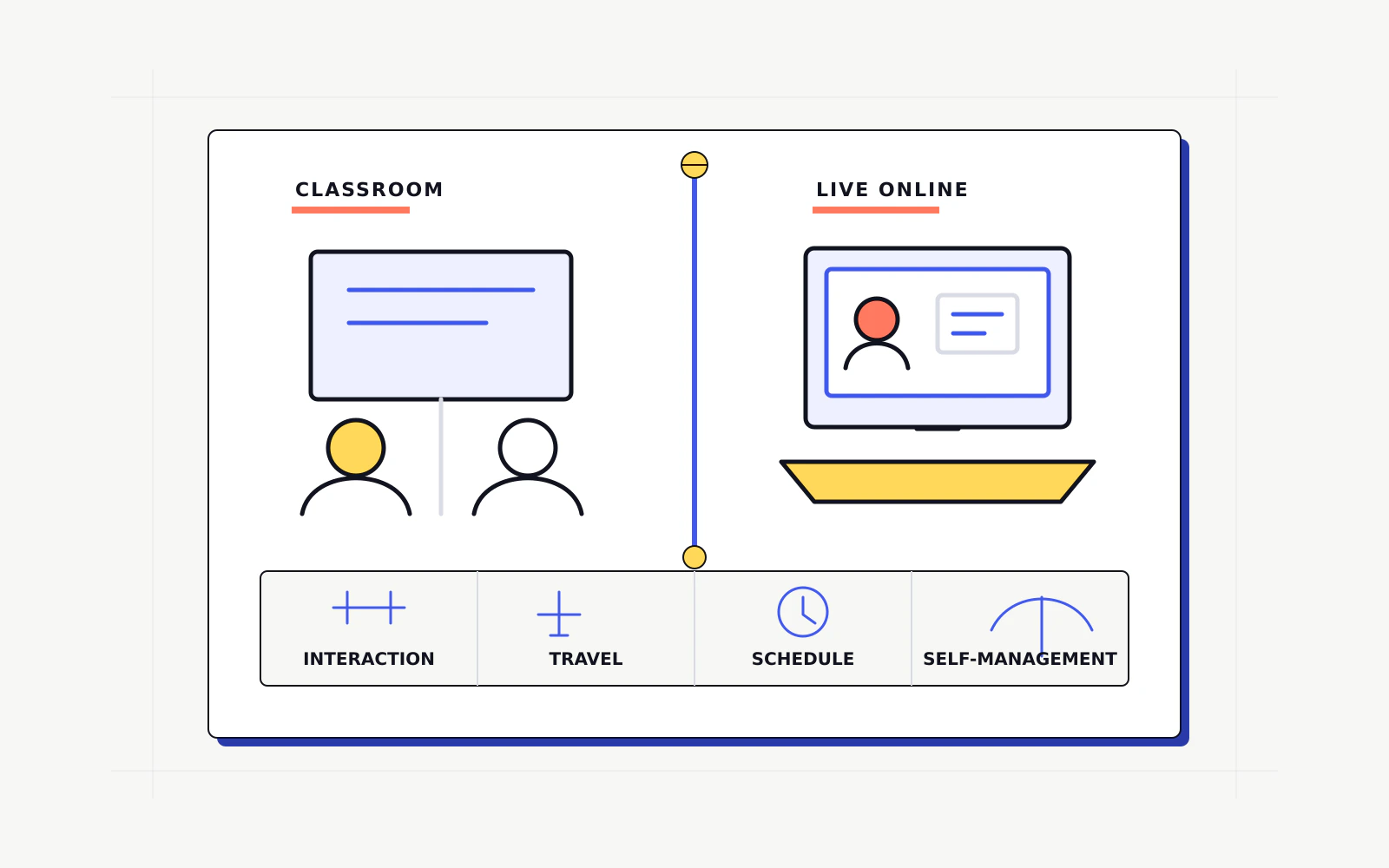
Key takeaways
- Neither mode is automatically better. Choose the environment in which you can attend consistently, practise between classes and ask for useful feedback.
- Compare live interaction, reviewed assignments, technical requirements, commute, peer support and weekly practice time before comparing convenience.
- Live online learning is different from recorded or self-paced learning. Confirm the timetable, attendance rules and recording policy in writing.
- Offline learning can provide physical routine and easier in-room interaction, but classroom presence does not prove that every learner receives detailed review.
- A strong programme should preserve the same learning outcomes, practical work, instructor access and assessment standards across both delivery modes.
Before choosing an online or offline digital marketing course in Ahmedabad, put the class times in your calendar. Check whether you can make the commute or join live from home, and ask how your trainer will review your work.
This guide compares the two modes without declaring a universal winner. It focuses on the factors that affect a beginner’s day-to-day learning: feedback, practical work, schedule, commute, technology, peer interaction, self-discipline and access to learning material.
Online or offline: the short answer
Choose offline learning when a physical routine improves your consistency, you can manage the Ahmedabad commute, and you learn more comfortably through immediate in-room discussion. Choose live online learning when travel is a meaningful constraint, you have reliable internet and a laptop, and you can protect the scheduled class and practice time at home.
Do not decide from the mode label alone. Two classroom courses can differ sharply in teaching quality and feedback. Two online courses can be completely different if one is live and interactive while the other is mainly a recording library. First confirm what actually happens during a typical week.
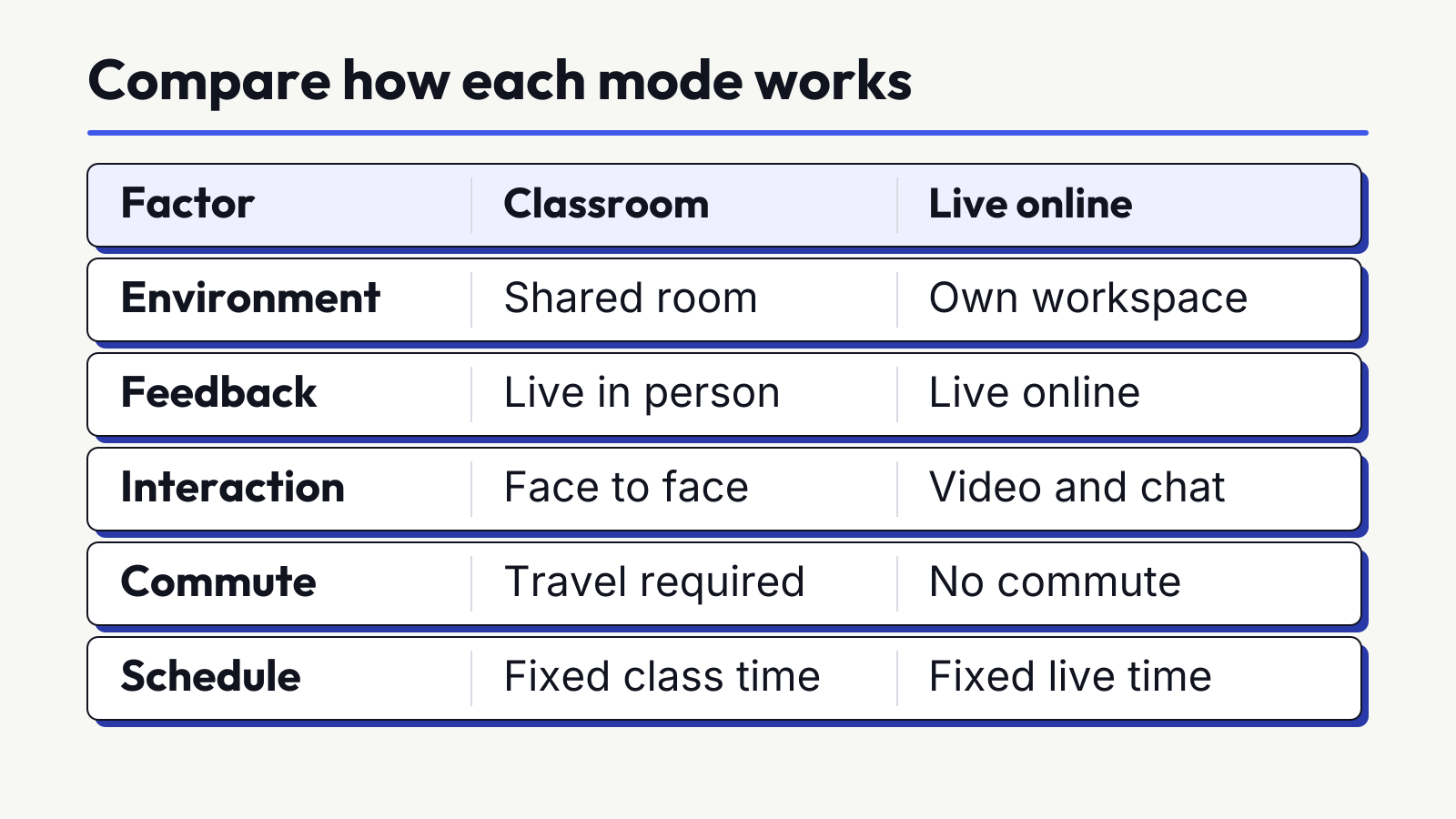
| Decision factor | Offline classroom | Live online classroom | Question to ask |
|---|---|---|---|
| Travel | Requires commuting and arrival time | Removes the daily commute | Can I attend the complete session consistently? |
| Interaction | Questions and discussion happen in the room | Questions use video, audio, chat or screen sharing | How does the trainer involve quieter learners? |
| Practice | May use classroom devices or personal laptops | Usually depends on the learner’s device and connection | What do I create myself during and after class? |
| Feedback | Can happen during desk-side or group review | Can happen through screen share and digital submissions | Which tasks receive individual correction? |
| Routine | Physical attendance can create a strong boundary | Requires a protected home or work schedule | What could interrupt my attendance each week? |
| Resources | May include printed and digital material | Usually relies more heavily on digital material | What can I keep and revisit after class? |
What should remain equal in both modes?
Delivery can change without lowering the academic standard. A credible provider should be able to show how the following elements remain comparable for classroom and live online learners.
- Learning outcomes: Both groups should work toward the same clearly stated capabilities.
- Curriculum scope: A mode should not quietly remove important topics or practical work.
- Instructor quality: Ask who teaches each batch and whether the same review standards apply.
- Practice expectations: Learners should complete meaningful work, not only watch demonstrations.
- Feedback: The provider should explain how work is submitted, corrected and improved.
- Assessment: Completion requirements should be visible before enrolment.
- Learning resources: Both modes should receive usable reference material and current links.
- Career claims: Neither mode should be sold using guaranteed placement or income.
India’s National Education Policy 2020 discusses online education alongside experiential and activity-based learning. The practical lesson for a course buyer is simple: screen delivery alone is not enough. Look for activity, interaction, feedback and work that can be reviewed.
Pro Tip
Ask to see one assignment brief, one example of trainer feedback and one improved submission. This reveals more about the learning process than a list of tools or modules.
When offline learning may fit better
Offline learning can be a good fit when the physical classroom removes distractions and makes attendance feel non-negotiable. It may also help learners who find it easier to ask follow-up questions while watching an instructor demonstrate a process in the room.
You need an external routine
A scheduled journey, fixed seat and visible peer group can create a clear boundary between class time and everything else. This matters if home responsibilities or notifications regularly interrupt online sessions. However, the routine only helps when the commute is sustainable for the full course, not merely during the first week.
You learn through in-room discussion
Some learners notice confusion earlier when they can compare their screen with a neighbour’s or ask the trainer to revisit a step immediately. A classroom can make informal questions easier. Confirm that the batch size and session design still give each learner a real chance to participate.
You want printed reference material
Printed readers can help learners annotate concepts and revisit them without opening another screen. They are most useful when they contain clear explanations, diagrams, examples and current resource links. A printed book is not a substitute for practical work or current platform guidance.
When live online learning may fit better
Live online learning can be a strong option when it removes a difficult commute and gives the learner more usable time for practice. It can also build comfort with screen sharing, digital submissions and remote collaboration. The benefits depend on reliable technology and a protected learning environment.
Travel would reduce attendance
Ahmedabad traffic and distance can turn a two-hour class into a much larger time commitment. Removing the commute may improve consistency for a learner who lives far from the classroom or works before class. Use the saved time deliberately for setup, practice or revision.
You have a suitable learning setup
A phone is not an ideal primary device for work involving spreadsheets, websites, advertising interfaces, analytics or side-by-side comparison. A learner should have a laptop, reliable internet, working audio and a space where a live session can continue without repeated interruption.
You can ask questions on screen
Online participation may involve speaking, using chat, sharing a screen and submitting files. If you tend to stay silent online, ask how the trainer checks understanding and invites questions. A smaller live group may still feel distant if participation is optional and feedback is vague.
Compare feedback before convenience
Digital marketing is learned through decisions and revision. A learner may need to select a target audience, map a keyword to a page, write an ad, choose a campaign objective, review a landing page or explain what a report means. The learning value comes from seeing why a decision is weak and improving it.
The Institute of Education Sciences practice guide on technology-supported postsecondary learning highlights timely and targeted feedback. When comparing modes, ask how quickly feedback arrives, whether it is specific to your work and whether you must submit a corrected version.
| Weak evidence | Stronger evidence | What it tells you |
|---|---|---|
| “Practical training included” | A sample assignment and review rubric | What the learner actually produces |
| “Personal mentoring” | Named review points and response times | How feedback is delivered |
| “Live projects” | Clear account access, learner role and permitted evidence | Whether the project is real and usable |
| “Lifetime support” | A written support period and channel | What support means in practice |
| “Recorded classes” | A written recording and access policy | Whether absence can actually be recovered |
Check the weekly learning process
A useful timetable shows more than class days. It explains the rhythm of explanation, guided work, independent practice, review and correction. Ask the provider to describe one normal week from the learner’s perspective. Use the duration framework to compare teaching hours and practice depth across the two modes.
- Before class: Is there preparatory reading, a setup task or a clear learning objective?
- During explanation: Does the trainer connect the topic to a business decision and show a worked example?
- During practice: Does each learner make decisions or merely watch the trainer?
- After class: What must be completed, and how long should it take?
- During review: Who checks the work, what feedback is given and is correction required?
- When stuck: Is there a scheduled doubt-clearing route with a defined response process?
The Government of India’s SWAYAM platform overview describes an online learning structure that combines instruction, reading material, assessment and a discussion route. A private course does not need to copy that platform, but the same questions are useful: what do you study, what do you practise, how is understanding checked and where do you ask for help?
Pro Tip
Run a one-week timetable test before enrolling. Block the class, commute or setup time, plus two practice sessions. If the week does not fit now, the problem is unlikely to disappear after payment.
Factor in the Ahmedabad commute
Distance should be measured in time, not kilometres. Test the route at the actual class hour and include parking, public-transport connections, weather and the return journey. A manageable weekend route may be difficult on a weekday evening. An online class removes travel but still needs preparation and uninterrupted attendance.
Use a simple weekly calculation:
Total weekly commitment = live class time + travel or setup + assignments + revision + submission and feedback time.
Do not treat the time saved online as free time if the course expects serious practice. Reserve it. For offline learning, decide whether the classroom structure is valuable enough to justify the additional travel and whether you can maintain it for the complete programme.
Use a seven-question mode check
- Attendance: Which mode can I attend reliably for the full course?
- Environment: Where can I concentrate for two hours without repeated interruption?
- Technology: Do I have a suitable laptop, connection, audio and backup plan?
- Interaction: Am I comfortable asking questions in the format the course uses?
- Practice: When will I complete work between live sessions?
- Feedback: How will my work be reviewed and how will I submit corrections?
- Total cost: What will I spend on travel, internet, equipment, tools and time in addition to tuition?
Write a short answer to each question for both modes. A clear pattern usually appears. If the answers remain close, attend a demonstration in each format and compare how the trainer explains, involves learners and responds to a weak answer. The question checklist can help you assess interaction during a demo class and record the evidence.
How SERA approaches both modes
SERA’s main programme uses one comprehensive curriculum across practitioner-led classroom training in Ahmedabad and live online classes. The programme runs for 16 weeks with three live, two-hour sessions each week. It covers Marketing Foundations, Content Marketing, SEO and AI Search, Performance Marketing, Social Media, and Analytics and Capstone.
One session each week is reserved for live use cases, questions, correction, feedback and doubt clearing. SERA caps classroom batches at 25 learners and live online batches at 40 learners. Learners receive searchable topic-based PDF reference material, while offline learners also receive printed module readers. Session recordings are not part of the standard candidate package, so online learners should plan to attend live.
You can review SERA’s current course structure before comparing the two modes. SERA does not promise guaranteed placement or income.
Make the final decision
Choose the mode that removes your biggest learning risk. If your risk is distraction and weak routine, a classroom may help. If your risk is travel and schedule loss, live online learning may help. If your risk is weak feedback, neither mode should pass until the provider shows its review process.
The goal is not to find the most convenient label. It is to create a repeatable weekly system in which you can understand a concept, apply it, receive correction and improve the result.
Frequently asked questions
Is online or offline digital marketing learning better for beginners?
Either can work for a beginner when teaching is live, structured and supported by practice and feedback. Choose according to attendance reliability, learning environment, technology, commute and comfort asking questions.
Is a live online course the same as a recorded course?
No. Live online learning happens at scheduled times with real-time instructor interaction. A recorded course is usually self-paced. Ask whether recordings are included, how long they remain available and how questions are answered.
What equipment is needed for online digital marketing classes?
A laptop, reliable internet, working audio and a suitable browser are practical basics. Some tasks may also need spreadsheet and document tools. Ask the provider for the complete technical and software requirements before enrolling.
Does offline learning provide more personal attention?
Not automatically. Personal attention depends on batch size, session design, trainer availability and the review process. Ask how many assignments receive individual feedback and how corrections are tracked.
Should commute time affect the decision?
Yes. Test the complete route at the actual class time and calculate the weekly travel commitment. Compare that cost with the structure and in-room interaction you expect from classroom learning.
Compare your weekly routine with SERA’s classroom and live online learning formats.

Mehul Shah
Mehul Shah is the founder and academic director of Sera Digital Marketing Academy in Ahmedabad. He has more than 11 years of experience in SEO, SaaS marketing and agency work. He writes about SEO, AI search and digital marketing, with a focus on how to audit websites, plan campaigns and measure results.