Key takeaways
- A course’s calendar length does not reveal its teaching hours, practice, feedback, project depth or assessment standard.
- A focused 3-month course can have more guided hours than a low-contact 6-month course, while a longer programme adds depth only when the extra time is structured.
- Compare live hours, independent work, guided practice, feedback cycles, project outputs, revision and assessment as separate fields.
- The better pace depends on the learner’s starting point, weekly availability, need for correction and ability to sustain the workload.
- SERA’s structure is 16 weeks, 48 live sessions and 96 live hours, including 12 material weeks and four consolidation and capstone weeks.
Two courses can run for the same number of months and give you very different amounts of practice. Compare the live hours, how often your work is reviewed and what you’ll finish by the end.
Do not begin with the assumption that longer means better or shorter means more practical. Ask what happens during the calendar period, how often a learner applies the material, who reviews the work and what evidence must be produced. Months are useful for planning a timetable, but they are not a quality score.
What does course duration tell you?
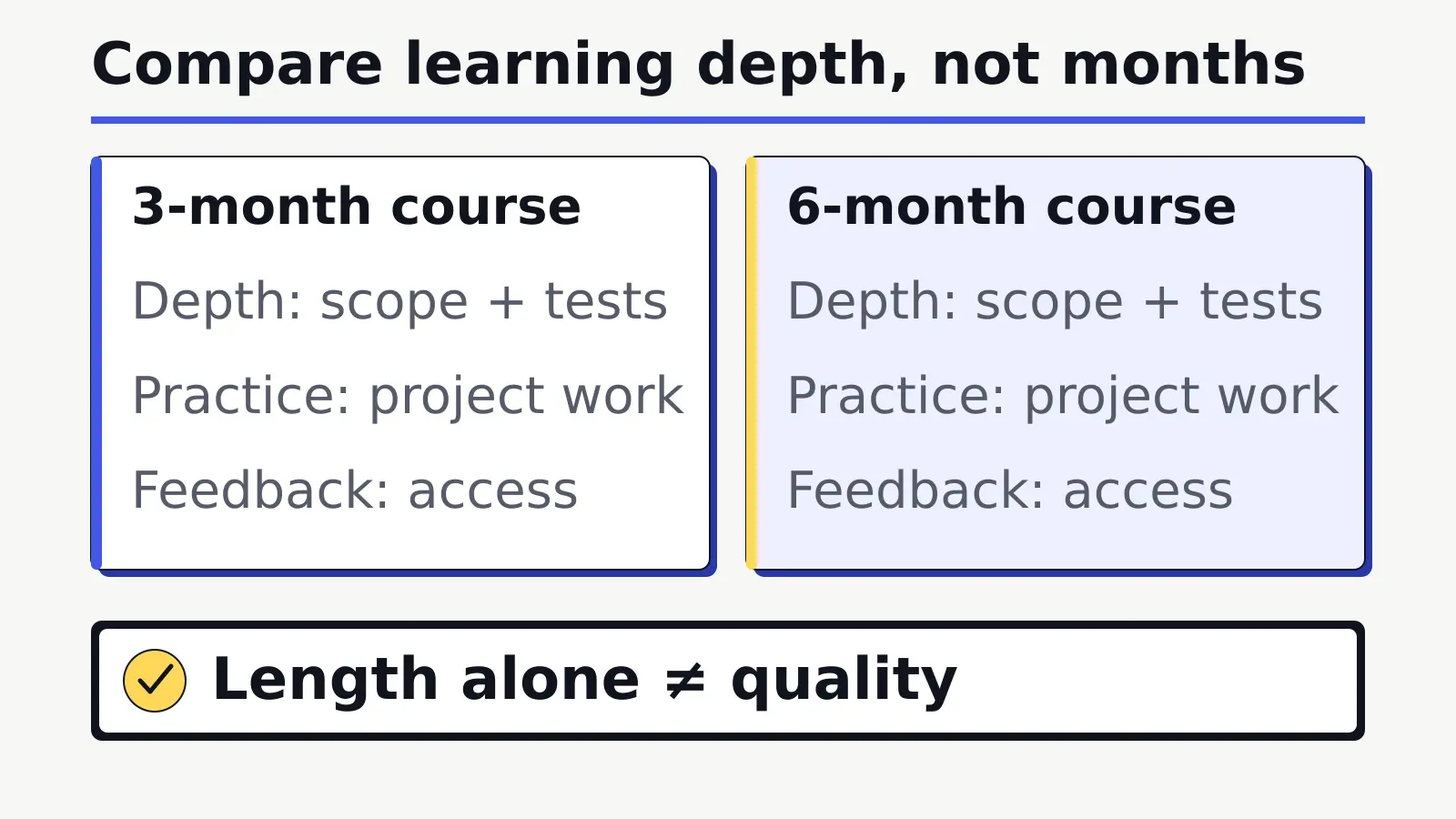
Digital marketing course duration does not reveal depth by itself. Compare total live hours, guided practice, feedback cycles, project scope, assessment, class pace and time available for revision. A focused 3-month course can be deeper than a low-contact 6-month course, while a longer programme may offer more practice only when the added time is structured and supported.
Calendar duration tells you the start-to-finish span. Guided hours tell you how much scheduled instructor contact exists. Independent work tells you what the learner must complete outside class. Practice and feedback show whether knowledge is applied, corrected and revised. Assessment shows what evidence is required for completion. Keep these measures separate.
| Field | What to verify | What it does not prove |
|---|---|---|
| Calendar length | Start date, end date and breaks | Total teaching or practice depth |
| Live hours | Session count, session length and weekly frequency | Quality of teaching or learner application |
| Independent work | Realistic weekly reading, tool and assignment load | That the work is reviewed |
| Guided practice | Exercises, builds, audits, briefs and reports | That mistakes are corrected |
| Feedback | Review frequency, turnaround and revision opportunity | That every learner receives the same support |
| Assessment | Criteria, outputs, presentation and completion standard | Employment, income or mastery |
Three months vs six months: the short answer
A 3-month course may suit a learner who can manage a concentrated weekly schedule and already has some foundations or study habits. A 6-month course may suit someone who needs more spacing, repeated feedback or a lower weekly load. Neither option is automatically deeper. Also compare online and classroom learning to judge how each format fits your routine.
| Structure | Possible advantage | Possible risk | Question to verify |
|---|---|---|---|
| 3-month course | Focused schedule and faster progression through linked topics | High weekly workload may leave little time for revision or correction | How many live hours, reviewed tasks and revision cycles fit each week? |
| 6-month course | More calendar space for practice, feedback and consolidation | Extra months may be low-contact access rather than structured learning | What additional teaching, practice, review and assessment occur in the added time? |
A simple illustration makes the distinction clear. A 12-week course with eight guided hours per week has 96 guided hours. A 24-week course with four guided hours per week also has 96 guided hours. They use different weekly intensity but the same guided-hour total. They are still not equivalent because project scope, feedback, independent work, assessment and teaching quality can differ.
Compare total live hours
Calculate contact time from the timetable rather than trusting a month label. Multiply sessions per week by session length and delivery weeks. Then ask whether breaks, orientation, assessment and project presentations are included in that count.
- How many live or instructor-led sessions are scheduled?
- How long is each session?
- How many delivery weeks contain live teaching?
- Are doubt clearing, project reviews and assessment live or self-paced?
- Are recorded-access months being counted as teaching months?
Contact time is still only one input. Ninety-six live hours can be used for lectures, demonstrations, practice, feedback or a mixture. Request the timetable or session map so you can see what the hours contain. Then check what a comprehensive syllabus includes so the hours can be assessed against actual learning tasks.
Compare guided practice
A topic list says what may be discussed. Practice evidence shows what learners are expected to do. Ask for the number and type of exercises, account builds, audits, content briefs, campaign structures, tracking plans, reports and presentations.
Distinguish demonstration from learner work. Watching an instructor build a campaign is not the same as creating a draft, explaining the choices and receiving correction. A strong practice description states the task, constraints, output, review method and revision opportunity.
Pro Tip
Ask to see an anonymised task brief and its review criteria. This reveals more about practice depth than a long list of software names or modules.
Compare feedback cycles
Feedback creates depth when it changes the learner’s next attempt. A useful cycle is: attempt, review, specific feedback, revision and recheck. One comment at the end of a course does not offer the same learning opportunity as repeated correction.
Verify who reviews the work, how feedback is delivered, the usual turnaround, whether revisions are required and how doubts are handled between sessions. Batch size can affect access, but a small batch alone does not guarantee good feedback. The process must be visible.
Compare project scope
A named “capstone” can be substantial or superficial. Request the brief, component list, constraints, review stages and presentation requirement. Look for connected work that asks the learner to make and defend decisions, not merely fill templates.
| Project field | Evidence to request | Weak signal |
|---|---|---|
| Output | Specific brief, plan, build, report or presentation | “Live project” without components |
| Constraints | Audience, objective, data, budget or policy assumptions | Open-ended task with no decision context |
| Review | Named checkpoints and feedback criteria | Submission without review |
| Revision | Time to improve after feedback | One final grade only |
| Evidence | Explainable artefact that protects private data | Certificate used as the only proof of work |
Compare pace and weekly workload
Weekly load includes live sessions, independent practice, reading, tool setup, group work, travel and revision. A shorter calendar can be manageable for someone with open weekday time but difficult during college exams or a busy work period. A longer calendar can reduce weekly intensity, but it can also make continuity harder if sessions are too far apart.
An Ahmedabad learner considering classroom delivery should include commute and fixed session timing. A live-online learner should check device, internet, participation and guided-practice requirements. Do not assume that online means self-paced or that classroom means more hours.
Compare assessment and revision
Ask what must be demonstrated for completion. Attendance, quizzes, practical outputs, presentations and a reviewed capstone test different things. A duration comparison is incomplete if the extra weeks are not linked to revision, integration or assessment.
- Which practical outputs are assessed?
- Are criteria shared before the task?
- Is revision built into the schedule?
- Can learners correct work after feedback?
- Does the final presentation connect several channels and decisions?
- What happens when a learner misses a live session or review?
Match duration to learner needs
| Learner situation | Possible fit | What to verify |
|---|---|---|
| Complete beginner | Enough spacing for foundations, practice and repeated correction | Entry assumptions, feedback frequency and revision support |
| Learner with foundations | A more concentrated structure may be manageable | Whether practice adds depth rather than repeating basics |
| Working professional | Lower weekly load may fit work commitments | Session timing, missed-session policy and assignment peaks |
| Learner needing more feedback | A structure with several review and revision cycles | Reviewer access and turnaround, not just total months |
These are planning cues, not outcome promises. Starting point and availability change what pace is sustainable. No calendar length guarantees employment, income, expertise or a portfolio of a particular standard.
Compare 3-month and 6-month structures
Place both options in the same comparison sheet. Use written information from the provider, then ask for clarification where a field is missing.
| Comparison field | 3-month option | 6-month option |
|---|---|---|
| Delivery weeks and breaks | Record exact dates | Record exact dates |
| Session count and length | Calculate live hours | Calculate live hours |
| Independent work | Record realistic weekly estimate | Record realistic weekly estimate |
| Guided practice | List tasks and builds | List tasks and builds |
| Feedback | Count review and revision cycles | Count review and revision cycles |
| Project scope | List deliverables and constraints | List deliverables and constraints |
| Assessment and revision | Record criteria and allocated time | Record criteria and allocated time |
| Support | Verify access and turnaround | Verify access and turnaround |
Do not convert missing details into a favourable assumption. “Six months access” may mean six months of teaching, or it may mean a shorter taught period followed by recordings. “Three-month intensive” may include strong guided practice, or it may compress lectures without enough correction. Ask what each label contains.
How SERA’s 16-week structure fits
SERA’s beginner digital marketing course runs for 16 weeks, with three live instructor-led sessions each week. Each session is two hours, producing 48 live sessions and 96 live instruction hours.
The first 12 weeks cover 24 two-hour topic units. The programme has 96 live hours in total. Beyond the topic units, class time includes worked examples, questions, feedback and practice across channels.
The final four weeks are reserved for consolidation, capstone work, revision, presentation, feedback and assessment rather than additional topic units. This design shows why the month label alone would miss the role of integration and revision. It does not guarantee a job, income or mastery. A successful learner should be able to complete realistic beginner work, interpret basic evidence, improve after feedback and present an integrated campaign as portfolio evidence.
Use the depth-comparison checklist
- Calculate total live hours from session count and length.
- Separate live teaching from recorded access and independent work.
- List the guided exercises and project outputs.
- Count attempt, feedback, revision and recheck cycles.
- Request capstone components and presentation requirements.
- Record revision, assessment and doubt-clearing time.
- Verify batch size, reviewer access and feedback turnaround.
- Map the weekly load against work, college, commute and other commitments.
Pro Tip
Ask the provider to complete the same fields for every duration option. A fair comparison uses one definition of live hour, practice task, reviewed project and feedback cycle.
Common duration comparison mistakes
- Choosing from months alone. Calculate guided hours and inspect what those hours contain.
- Treating recorded access as live teaching. Record each format separately.
- Counting topics instead of practice. A long syllabus does not prove that learners apply or revise the material.
- Accepting project claims without review details. Ask for outputs, checkpoints and criteria.
- Assuming longer means advanced. Added calendar time may or may not contain deeper work.
- Accepting guaranteed job readiness. Duration cannot guarantee placement, income or employment.
Compare the hours, practice and feedback before comparing the number of months.
Frequently asked questions
Is a 3-month digital marketing course enough for a beginner?
It can provide meaningful beginner learning when it includes sufficient live hours, guided practice, feedback, revision and assessment at a sustainable weekly pace. Three months alone cannot prove depth or an employment outcome.
Is a 6-month course better than a 3-month course?
Not automatically. The longer option is deeper only if the added time contains useful teaching, practice, review, projects, revision or assessment. Compare the same fields for both courses.
How many hours should a digital marketing course include?
There is no universal hour total that guarantees competence. Verify live hours, independent work, practice, feedback and assessment separately, then judge whether the workload suits your starting point and weekly availability.
Does course duration include projects and feedback?
It depends on the provider. Ask where projects, review cycles, revision, presentation and assessment appear in the timetable. Do not assume that access months or a project label include live feedback.
How long is SERA’s digital marketing course?
SERA’s beginner course runs for 16 weeks, with three two-hour live sessions each week. That is 48 live sessions and 96 live hours, including material, guided application, consolidation, capstone, revision, presentation, feedback and assessment time.

Mehul Shah
Mehul Shah is the founder and academic director of Sera Digital Marketing Academy in Ahmedabad. He has more than 11 years of experience in SEO, SaaS marketing and agency work. He writes about SEO, AI search and digital marketing, with a focus on how to audit websites, plan campaigns and measure results.