
Key takeaways
- A good syllabus connects every topic to a decision, practical task, feedback point or reviewable output. A long module list is not proof of depth.
- Beginners need foundations before platform execution: customers, journeys, positioning, channels, websites, landing pages and measurement.
- A current programme should integrate content, SEO and AI Search, paid media, social media, analytics and cross-channel planning.
- Look for guided practice, individual correction, assessment and a capstone that shows how decisions connect across channels.
- Current platform workflows need regular review, while durable principles such as audience, intent, message, evidence and measurement should remain clear.
Open a digital marketing course syllabus and find the first assignment. Can you tell what you’ll make, who will review it and when you’ll revise it? Use those questions to compare course outlines before you compare fees.
This 2026 guide gives you a practical framework for evaluating a course outline. Use it to inspect learning outcomes, topic sequence, practical work, feedback, tools, assessment, resources and the final capstone before you compare fees or duration.
What should a syllabus include?
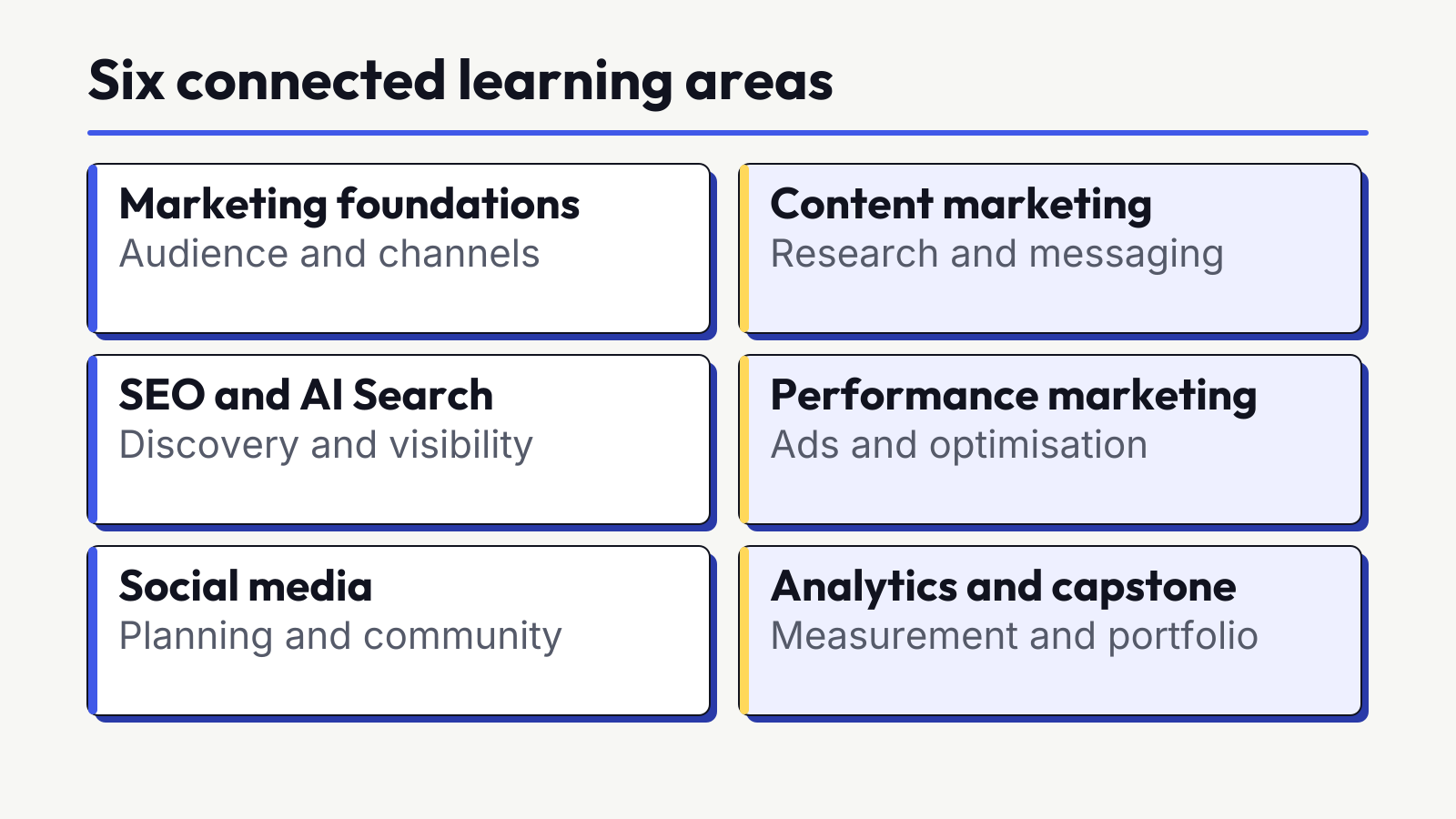
Quick answer: A comprehensive beginner syllabus should include Marketing Foundations, Content Marketing, SEO and AI Search, Performance Marketing, Social Media, and Analytics and Capstone. Each area should specify learning outcomes, guided application, feedback and evidence the learner creates. It should also explain course hours, assessment, resource access and how fast-changing platform instructions are kept current.
Coverage is only the first test. A course can list SEO, Google Ads, Meta Ads, social media and analytics while giving each topic very little teaching or practice. Ask how topics are sequenced, what work learners complete and what happens after the first attempt.
| Syllabus element | What it should explain | Evidence to request |
|---|---|---|
| Learning outcomes | What learners should be able to understand or do | Specific capability statements |
| Topic sequence | Why one concept comes before another | A week, module or unit map |
| Practical work | What each learner creates independently | Assignment briefs and examples |
| Feedback | How work is reviewed, corrected and improved | Rubric, comments and revision process |
| Assessment | What is required for course completion | Criteria, deadlines and submission rules |
| Resources | What learners can revisit after class | Sample reader, worksheet or reference pack |
| Currency | How changing platform workflows are updated | Version dates and update process |
Start with marketing foundations
Platform skills become easier to apply when a learner understands the business context. Foundations should explain what marketing does, how it differs from sales, how organisations create value and how a target market becomes a useful audience or customer profile.
Customers, positioning and journeys
A beginner should learn how to distinguish a target market, target audience, ideal customer profile and persona. The syllabus should connect customer needs and pain points to a positioning statement, offer, message and journey. It should also clarify funnel stages, touchpoints and the difference between a prospect, lead, opportunity and customer.
Channels and their roles
Search, content, paid media, social media, email and analytics should not be introduced as isolated tool stacks. A foundation module should explain which channels create discovery, capture demand, nurture consideration, support conversion or build retention. It should also distinguish owned, earned and paid media.
Websites, landing pages and measurement
Learners should understand how a page goal, headline, message, evidence and call to action work together. Basic metrics should be introduced as answers to business questions, not as a list of abbreviations. This foundation later supports content, SEO, advertising and analytics work.
Pro Tip
Choose one module from the brochure and ask, “What decision will I learn to make, what will I create and how will that work be reviewed?” Repeat the test for three different modules.
Cover six connected learning areas
A comprehensive course does not need a separate course for every channel. It needs a clear learning path across the major areas and enough depth for a beginner to produce credible work. The six-part structure below is a useful evaluation framework.
1. Marketing foundations
Look for customer research, positioning, journeys, funnels, channel roles, websites, landing pages and core metrics. The module should establish a shared vocabulary and show how marketing decisions support a business goal.
2. Content marketing
Content training should include messaging, research, briefs, editorial planning, webpages, search content, social posts, email and advertising copy. It should also cover distribution and measurement. A useful assignment might ask the learner to create a brief, write several channel adaptations and explain how each version serves the audience and stage.
3. SEO and AI Search
A current SEO module should cover keyword and intent research, page mapping, on-page SEO, internal linking, technical diagnosis, audits and authority. It should introduce AEO, GEO, entities and citations without promising rankings or AI mentions. Google’s SEO Starter Guide frames SEO around helping search engines understand content and helping users discover and assess it. A course should keep that user value visible while teaching search workflows.
4. Performance marketing
Paid-media learning should connect campaign objectives, audiences or keywords, ads, budgets, landing pages, tracking and optimisation. Google’s official explanation of Google Ads account organisation shows how campaigns and ad groups organise settings, budgets, ads and keywords. Learners should use the structure to plan a coherent campaign, not merely memorise interface locations.
Meta Ads coverage should explain the relationship between campaign, ad set and ad, plus objectives, audience, placements, creative, offer, message match and measurement. Platform-specific details should be presented as current workflows with a visible review date.
5. Social media
A social-media module should move from platform selection and audience to content strategy, pillars, formats, briefs, calendars, community management and reporting. It should explain how organic activity, paid distribution and customer response can work together while maintaining brand and moderation rules. Connect the module outputs and see what a practical portfolio should demonstrate through reviewable examples.
6. Analytics and capstone
Analytics should connect setup and data collection to reports, important actions and business questions. Google’s beginner Analytics learning path includes property setup, data collection, reports, conversions and access. A course should then teach learners to distinguish an observation from an insight and turn evidence into a recommendation.
The capstone should combine research, message, channel choices, content, paid-media planning, measurement and presentation. The goal is not to prove expert mastery. It is to demonstrate that a beginner can connect decisions, explain assumptions, respond to feedback and improve the work.
Look for practical outputs
A syllabus is easier to evaluate when it names the work learners produce. “Practical SEO” is vague. “Create a keyword map, write an on-page brief, run a basic audit and explain the recommended priorities” is specific.
| Learning area | Possible beginner output | What review should examine |
|---|---|---|
| Foundations | Audience profile, positioning statement and journey map | Evidence, assumptions and channel fit |
| Content | Brief, webpage section, social adaptations and email sequence | Audience, message, structure and CTA |
| SEO and AI Search | Keyword map, content brief, on-page review and audit priorities | Intent, page ownership, evidence and technical reasoning |
| Performance | Campaign plan, ad variations, audience or keyword structure and landing-page review | Objective, message match, budget logic and tracking |
| Social media | Platform plan, content pillars, calendar and community response guide | Capacity, consistency, relevance and measurement |
| Analytics | Report commentary and recommendation | Accuracy, context, interpretation and action |
| Capstone | Integrated campaign plan and presentation | Connections, trade-offs, evidence and response to feedback |
Simulated work can be valuable when it uses a realistic brief, transparent assumptions and a proper review process. A learner should never present a simulation as a real client result. The syllabus should separate demonstration, guided practice, simulation and genuine account work.
Check the feedback and assessment plan
Teaching is not complete when an assignment is submitted. The syllabus should show which work receives feedback, who reviews it, when comments arrive and whether the learner must revise the output.
- Knowledge checks confirm that essential terms and relationships are understood.
- Guided application lets learners practise a process with support.
- Independent work shows whether the learner can apply the process without copying a demonstration.
- Review and correction make the reasoning visible and improve the result.
- Capstone assessment tests whether separate skills can be connected into one plan.
India’s National Education Policy 2020 discusses experiential and activity-based learning. For a course buyer, this supports a practical test: look beyond the topics and ask how learners apply, discuss, receive feedback and demonstrate understanding.
Pro Tip
Ask whether correction is required. Feedback that is never applied may not change the learner’s process. A revision log or second submission shows whether improvement is part of the course design.
Separate principles from interfaces
Advertising, analytics, search results and marketing tools change. A current syllabus should teach the interface needed for practice, but it should also explain the principle behind the step. A learner who only memorises where a button appears may struggle after an update.
Ask how the provider reviews fast-changing content. Current screenshots should have a version or review date. Official platform training such as Google Skillshop’s Google Ads learning can support product-specific updates, but platform certification is not a substitute for broader strategy, practice and feedback.
| Durable principle | Changing workflow | What the syllabus should do |
|---|---|---|
| Match a message to an audience and intent | Campaign objective names and setup screens | Teach both the decision and the current steps |
| Use evidence to prioritise SEO work | SERP layouts and tool interfaces | Explain reasoning and date screenshots |
| Connect an ad promise to a landing page | Ad formats and placement controls | Review message match across current formats |
| Measure meaningful actions | Analytics menus and event setup | Start with the business question, then show setup |
Integrate AI across the syllabus
AI should not appear as one disconnected lesson called “prompt engineering”. It should be introduced where it changes a real marketing workflow, with clear limits and human review. For example, learners may use AI to organise research notes, explore message variations, critique a brief, summarise a dataset or identify questions that need verification.
The syllabus should explain what the learner remains responsible for. That includes checking sources, protecting confidential information, identifying unsupported claims, preserving the intended audience and brand voice, reviewing bias, and making the final decision. A generated answer should be treated as material to evaluate, not proof.
| Learning area | Possible AI-assisted use | Human review requirement |
|---|---|---|
| Research | Group notes or suggest follow-up questions | Open and verify the original sources |
| Content | Explore outlines or alternative messages | Check accuracy, usefulness, originality and brand fit |
| SEO and AI Search | Compare entities or extract candidate questions | Confirm intent in the live results and map one owner page |
| Advertising | Create testable variations from an approved brief | Review policy, promise, evidence and landing-page match |
| Analytics | Draft possible observations from supplied data | Check the calculation, context and recommended action |
A current syllabus should also explain where AI should not be used. Learners should not paste private client data, personal information, unpublished business material or account credentials into an unapproved tool. They should not invent results, testimonials, citations or experience. The provider should state which tools are used, what data learners may enter and how AI-assisted work should be disclosed in assignments.
Judge tools and certifications carefully
A tool list can help you understand the practice environment, but it does not prove capability. Tools change, free plans become limited and interfaces are redesigned. Ask what decision each tool supports and whether learners use it themselves, watch a demonstration or work from prepared screenshots.
- Named access: Which tools are provided, for how long and under whose account?
- Purpose: What research, execution or measurement task does each tool support?
- Fallback: Can the principle still be taught when a paid plan is unavailable?
- Evidence: What learner-created output demonstrates that the tool was used thoughtfully?
- Currency: When was the workflow last reviewed against the official documentation?
Platform learning and certificates can support a beginner’s development, but confirm who issues each certificate and what assessment it represents. An academy’s certificate of completion is different from a platform credential, a university qualification or professional experience. None of them guarantees employment or campaign performance.
Spot an outdated or superficial outline
Warning signs usually appear in the way the syllabus describes learning, not only in the topic list. Investigate an outline when it:
- Promises mastery of many platforms without showing time, outcomes or practice.
- Lists obsolete products or analytics systems without an update note.
- Uses “live project” without defining the account, learner role, data access and permitted evidence.
- Treats SEO as keyword repetition or advertising as button-clicking.
- Adds AI tools without verification, privacy or disclosure rules.
- Contains no feedback, revision, assessment or capstone process.
- Depends on guaranteed placement, salary, ranking or income claims.
- Uses one generic assignment for every learner without any review criteria.
Ask the provider to explain one recent curriculum change and why it was made. A specific answer can show that the course is actively reviewed. A vague claim that the syllabus is “always updated” provides little evidence.
Evaluate hours and depth
Course duration in months does not reveal teaching depth. Compare total live hours, guided practice, independent work, feedback sessions and the final project. A programme can run for many months while meeting infrequently. A shorter programme can be intensive but difficult to absorb. Use the worked framework to compare course duration and teaching depth on the same basis.
- How many hours involve new instruction?
- How many hours are reserved for guided application?
- How much independent work is expected each week?
- Which sessions focus on questions, correction and feedback?
- How much time is reserved for revision, integration and the capstone?
- What happens if a learner needs more time to improve an output?
Use hours with evidence. More time does not automatically mean better learning, but the course should allocate enough time for explanation, application and revision across its stated outcomes.
Review the learning resources
Slides are presentation aids, not always complete reference material. Ask what you receive after class and whether the material remains understandable without the trainer speaking over it. Useful resources may include topic readers, diagrams, worked examples, checklists, templates, source links and glossaries.
The W3C accessibility principles emphasise content that is perceivable, operable, understandable and robust. A learner can use a simpler practical check: is the material readable on the intended device, clearly structured, high in contrast and supported by text alternatives when an image carries information?
Confirm access duration and replacement policy in writing. Do not assume that “digital access” means lifetime access, a dedicated learning platform or complete recordings.
How SERA structures the programme
SERA’s comprehensive beginner programme runs for 16 weeks, with 48 live sessions and 96 hours of live instruction. The first 12 weeks cover 24 two-hour topic units. In the final four weeks, you apply what you’ve learnt across channels, revise and present your capstone, and receive feedback and an assessment.
The six modules are Marketing Foundations, Content Marketing, SEO and AI Search, Performance Marketing, Social Media, and Analytics and Capstone. Learners create research, content, SEO, campaign, social, analytics and integrated capstone outputs. One live session each week is reserved for use cases, questions, correction, feedback and doubt clearing.
The course assumes little or no prior marketing, advertising, analytics, SEO-tool or reporting experience. No coding, design or previous marketing experience is required. You can review SERA’s current course structure before asking how its outcomes and practical work fit your goals.
Use a syllabus review checklist
- Are learning outcomes specific enough to verify?
- Does the sequence move from foundations to channel work and integration?
- Does every major area include learner-created work?
- Are guided practice and independent practice clearly separated?
- Which assignments receive individual feedback?
- Must learners correct or resubmit weak work?
- Are platform screenshots and workflows dated and reviewed?
- Are tools, accounts and any additional costs named?
- Does the assessment match what was actually taught?
- Does the capstone connect channels and measurement?
- Are resource format and access terms clear?
- Are certificate and career-support claims accurate and written?
Score each item as clear, partly clear or missing. Then ask for evidence where the answer depends on a broad promise. The checklist does not choose a course for you. It makes the comparison visible.
Frequently asked questions
What are the main subjects in a digital marketing course syllabus?
A comprehensive beginner syllabus commonly includes marketing foundations, content marketing, SEO and AI Search, performance marketing, social media, analytics and a final integrated project. Check the outcomes and practice within each area.
Should a syllabus include AI tools and AI Search?
It should explain responsible AI-assisted workflows and how search discovery is changing, including AEO, GEO, entities and citations where appropriate. These topics should support sound research and judgement, not replace fundamentals or promise AI visibility.
How much practical work should a course include?
There is no universal hour count. Ask what each learner creates, which work receives individual feedback and whether correction is required. Reviewable outputs are more informative than a claim of “100% practical training”.
Do beginners need coding or design experience?
Not for a broad beginner programme. Basic confidence with a laptop, browser, email, documents and spreadsheets is useful. A course should state any additional technical or creative prerequisites clearly.
Does completing a syllabus guarantee a job?
No. A course can help a learner build skills, practical evidence and interview readiness, but employment also depends on attendance, work quality, communication, applications and employer requirements. Avoid guaranteed placement or income claims.
Compare SERA’s outcomes, practical work and feedback model with your syllabus checklist.