Key takeaways
- You can begin learning digital marketing after Class 12. Your stream does not prevent you from building beginner skills.
- A degree and a practical course solve different needs. You can choose either route or combine them without treating one as a guaranteed shortcut.
- Judge a course by live teaching, guided practice, feedback, portfolio evidence and written policies, not by tool logos or placement promises.
- Start with small projects that show research, reasoning, execution and revision. A portfolio should make your process visible.
- SERA’s beginner programme runs for 16 weeks with three live two-hour sessions each week, in offline Ahmedabad and live online formats.
If you’re considering a digital marketing course after Class 12, try a small project first. You could write a page for a college club, look up what people search for or plan a week of posts. That gives you something concrete to discuss when you compare courses.
This guide is for students comparing college, short courses, self-study and work-based learning. It explains what each route can and cannot do, how to test your readiness, how to create beginner evidence and how to compare course options in Ahmedabad without relying on promises. If you are under 18, involve a parent or guardian and obtain their consent before enrolling, paying fees or creating accounts that require adult agreement.
Can you start learning digital marketing after 12th?
Yes. Digital marketing is learnable at beginner level after Class 12 because the starting concepts do not require a particular school stream or previous marketing job. You can begin by understanding audiences, offers, customer journeys, websites, content, search, advertising, social media and measurement. The challenge is not gaining access to information. It is learning how the parts connect and producing work that can be reviewed.
A sensible first goal is not “become an expert quickly”. It is “build a reliable foundation and complete a few small pieces of evidence”. For example, you might research an audience, write a content brief, improve a sample landing page, map keywords to pages, draft a social content plan or explain what a basic analytics report suggests. These outputs reveal more than a list of videos watched.
You must be 18 or older to enrol at SERA. You can start learning digital marketing after Class 12 even if you’re younger.
You do not need coding, professional design, advertising-account or analytics experience to start SERA’s beginner course. You do need basic browser, email, document and spreadsheet ability, basic written and spoken English, a Google account and access to a laptop when guided application requires it. Similar readiness questions are useful when you compare any course.
- Start now if: you are curious about how businesses reach people online and can protect regular time for practice.
- Start with orientation first if: you recognise channel names but cannot yet explain what the work involves.
- Pause and plan if: your college entrance, board re-evaluation, relocation or other commitment leaves no stable study time.
Should you choose a degree, a course or both?
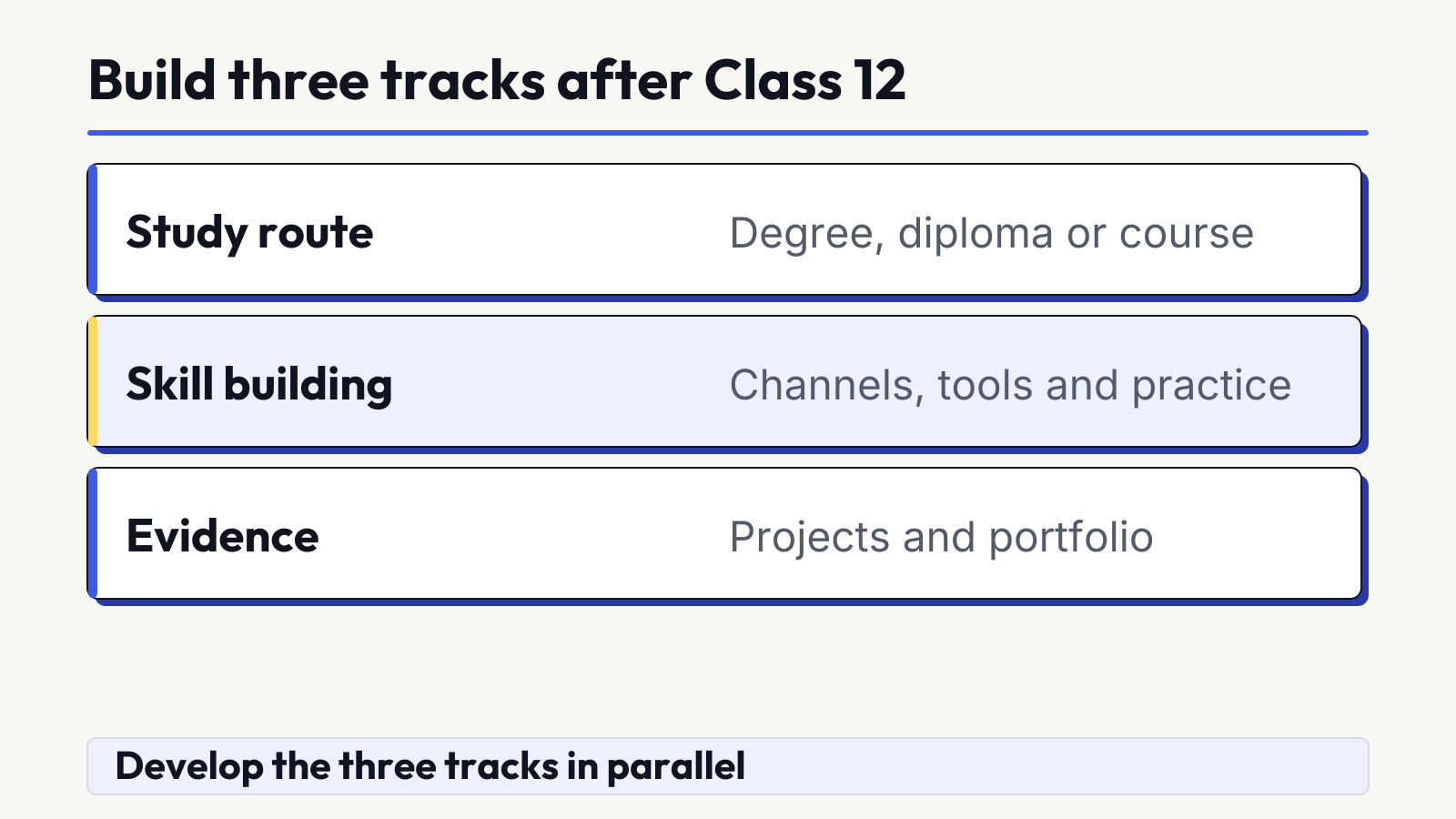
A degree and a focused skills course are not direct substitutes. A recognised degree provides a broader academic pathway and may matter for future study or eligibility rules set by employers and institutions. A practical course can provide a shorter, more structured way to practise current marketing tasks. Combining them can work when the total workload is realistic.
| Route | What it can provide | What to verify | Common risk |
|---|---|---|---|
| Degree | Broad academic development, recognised qualification pathway and time to explore subjects | Institution recognition, programme status, curriculum, mode and progression options | Assuming a degree title automatically creates practical marketing evidence |
| Short practical course | Focused instruction, guided tasks, feedback and a quicker test of interest | Live hours, assignments, feedback, trainer role, policies and portfolio outputs | Choosing by speed, tool count or a job guarantee |
| Degree plus course | Academic study alongside applied practice | Timetable fit, travel, assignment peaks, exam periods and recovery time | Overloading the week and completing neither route well |
| Self-study first | Low-risk exploration and flexible pacing | A defined syllabus, current official sources and a plan for external feedback | Collecting information without producing or revising work |
Before paying for any degree or distance programme, verify its status through the relevant official source. The University Grants Commission directory publishes information about higher education institutions. The official UGC guidance explains that recognition must be checked for the exact institution, programme and admission session. Do not rely on a logo in an advertisement.
Keep academic recognition and practical training claims separate. A private skills certificate can document course participation or assessment, but it should not be described as a university degree or government qualification unless the official awarding and recognition details support that statement. Likewise, a recognised academic programme can still require additional practice before you can perform marketing tasks confidently. Write down what recognition you need for future study and what practical capability you want now, then evaluate each route against the correct need.
Pro Tip
Create one weekly timetable containing college classes, travel, assignments, course sessions, practice and rest. If the plan works only in a perfect week, reduce the load before enrolling.
Does your Class 12 stream matter?
Your stream can influence your starting strengths, but it does not lock you into or out of digital marketing. Commerce, arts, science and vocational learners may arrive with different habits. None of those backgrounds removes the need to learn audiences, messages, channel roles, measurement and ethical practice.
- Commerce: You may recognise business, economics or accounting ideas. Practise turning business objectives into audience and channel decisions.
- Arts or humanities: You may bring strengths in language, interpretation, society or communication. Add spreadsheet confidence and disciplined measurement.
- Science: You may be comfortable with structured reasoning, experiments or data. Add customer empathy, persuasive writing and brand context.
- Vocational study: You may already think in terms of tasks and outputs. Build the underlying marketing reasoning so execution is not mechanical.
Do not turn these observations into stereotypes. A science learner can be an excellent writer, and an arts learner can be confident with data. Use your stream only as a prompt for a personal skills audit. A beginner course should teach shared foundations and give every learner repeated opportunities to practise weaker areas. Before enrolling, understand the core digital marketing syllabus and compare it with your readiness.
Check your starting skills and learning readiness
Readiness is less about knowing marketing terms and more about being able to learn through action. Use the following check before choosing a timetable or format. A “not yet” answer is not a failure. It shows what to prepare.
- Digital basics: Can you organise files, use email, work in documents and enter simple data in a spreadsheet?
- Reading: Can you compare two sources, identify what each one actually supports and take clear notes?
- Writing: Can you explain an idea in simple English, then revise it after feedback?
- Numbers: Are you willing to work with percentages, tables and basic performance measures without avoiding them?
- Consistency: Can you protect session time and a separate practice block every week?
- Feedback: Can you show unfinished work, accept correction and make a stronger second version?
- Access: Do you have reliable access to a laptop and internet for the tasks your chosen course requires?
If several basics are missing, spend two weeks preparing. Practise file naming, a simple spreadsheet, a short written summary and a five-slide explanation of a familiar brand. Explore structured learning options on official public platforms such as the SWAYAM Plus beginner digital marketing course and the Skill India Digital Hub course catalogue. Availability and course details can change, so review the current page and terms before relying on a listing.
You can also inspect a current National Qualifications Register digital marketing listing to understand how an approved qualification states eligibility, learning modules, awarding bodies and validity. A private course does not become a government qualification merely because it teaches similar topics. Check the awarding body and official listing whenever formal recognition matters to you.
Try a short readiness exercise before attending a counselling session. Choose a familiar local business category, identify one likely audience, write three questions that audience may ask, find two relevant official or primary sources and organise the observations in a simple spreadsheet. Then turn one observation into a short webpage outline. The exercise tests research, organisation, writing and basic tool use without requiring previous marketing knowledge. Note where you became confused because those gaps should influence the support you seek from a course.
Build a beginner portfolio
A beginner portfolio is a small collection of work that shows how you think. It does not need client names, paid campaign results or polished claims. It should make your brief, evidence, decisions and revisions easy to follow. Label simulations clearly so a reviewer never mistakes practice for client work. The project workflow shows how to start a beginner digital marketing portfolio with clear briefs and revisions.
- Pick a safe practice subject. Use a fictional brand, a personal project or a public-interest topic. Do not imply a relationship with a real business.
- Write the brief. State the audience, problem, goal, channel and limits. A one-page brief prevents random execution.
- Collect evidence. Record search observations, official sources, audience questions and assumptions. Separate observation from interpretation.
- Create the first version. Produce a content brief, landing-page outline, keyword map, social plan, ad concept or basic measurement plan.
- Request feedback. Ask a trainer, mentor or peer to comment on the reasoning and output against specific criteria.
- Revise and explain. Keep the first version, final version and a short note about what changed and why.
A useful starter set might include three projects. Project one can map a customer journey and channel roles. Project two can turn audience research into a content brief and sample page. Project three can propose a small integrated campaign with basic tracking. Three complete, well-explained projects are more credible than twenty disconnected screenshots.
Present each project so another person can review it in five minutes. Begin with the question and intended audience. Show the most important evidence, then the output and revision. End with limitations and the next test you would run. Remove private data, unlicensed images and copied work. If you use an AI assistant, disclose where it helped, verify the output and keep your own reasoning visible. The portfolio should demonstrate judgement, not the ability to paste an unreviewed response.
Pro Tip
Add a “feedback received” and “revision made” box to every portfolio item. It proves that you can improve work, which is more useful than pretending the first attempt was perfect.
Plan the workload alongside college or further study
Course duration alone does not show the real workload. Add live sessions, travel, preparation, assignments, revision and college commitments. SERA’s programme includes three live sessions per week, each lasting two hours. That is six live hours weekly before personal practice. Offline learners must also account for travel in Ahmedabad. Live online learners need a quiet place, reliable internet and the discipline to participate at the scheduled time.
Build a normal-week plan and an exam-week plan. In a normal week, reserve session time plus smaller practice blocks. During internal assessments or university examinations, identify which work can move and which attendance expectations remain. Ask the provider how missed sessions are handled. SERA does not include session recordings as a standard candidate package, so do not assume you can routinely catch up by watching later.
- Keep at least one evening or half-day free from both college and course work.
- Break assignments into research, first draft, feedback and revision rather than one long final-night task.
- Use a calendar for exam dates, submissions and live sessions before the batch begins.
- Tell the trainer early when a genuine academic clash appears. Do not wait until work is overdue.
- Review your plan after two weeks and reduce optional commitments if quality is falling.
How to choose a course in Ahmedabad
Compare courses using evidence you can inspect. Location and price matter, but they should not replace questions about what happens in class and what you will produce. The same checklist works for offline Ahmedabad and live online options.
- Define your purpose. Decide whether you are exploring the field, complementing a degree, preparing for an internship or building skills for a family business.
- Inspect the sequence. Look for foundations before channel execution, then practice, feedback, revision and an integrated project.
- Count live hours correctly. Separate instruction, guided practice, doubt clearing, project review and assessments. Ask whether “support” is live or recorded.
- View real learning evidence. Request an anonymised assignment, the criteria used to review it and an improved version after feedback.
- Meet the actual trainer. Confirm who teaches each area, how questions are handled and whether the demo reflects the normal class.
- Check batch size. Ask how many learners share live feedback time and what happens when several need help.
- Request written terms. Confirm the full payable amount, tools, schedule, attendance, refunds, transfers, materials and placement-support conditions.
- Test the commute or technology. Visit the Ahmedabad location at the expected time, or test the online platform, device, audio and internet setup.
Be cautious when a provider leads with guaranteed placement, guaranteed income, fixed ranking outcomes or a large salary number without a defined cohort and evidence. Training can support capability, but hiring and business results depend on many factors beyond a course. Also question very large tool lists. Learners need enough access to practise relevant workflows, not dozens of logos they only see in demonstrations.
Use a demo class to observe the teaching process, not only the trainer’s confidence. Notice whether the explanation starts from a clear learner outcome, whether examples match the stated level and whether students are invited to think rather than copy. Ask what happens after an incorrect answer or weak assignment. A course that includes correction and revision is offering a different learning experience from one that counts attendance as completion. Confirm that the normal batch follows the same approach shown in the demo.
What outcomes are realistic after Class 12?
A realistic beginner outcome is the ability to explain the marketing system, complete supervised tasks and present a small body of work. It is not instant expertise across every channel. After a structured beginner programme and consistent practice, a successful learner should be able to discuss audiences and journeys, create basic content and research outputs, review simple SEO or campaign elements and interpret introductory data with appropriate support.
You may then use that evidence to explore internships, trainee responsibilities, college projects, volunteer work or supervised contributions to a business. Whether you receive an opportunity depends on your education, portfolio, communication, location, application quality, interview performance and the organisation’s criteria. A course should not promise a particular role, placement, income or hiring timeline.
Expect to remain a beginner after the first course. The useful change is that you can make better decisions about the next step. You may discover that you enjoy research and SEO, content and messaging, paid media, social media, analytics or integrated planning. Specialisation should follow informed practice, not a trend or a single tool demonstration.
Measure progress with capability statements you can demonstrate. Examples include “I can explain why a keyword fits a page”, “I can revise a content brief after feedback” and “I can separate a data observation from a recommendation”. Keep a skills log with a date, task, feedback point and next action. This prevents vague confidence from replacing evidence and helps you explain your learning clearly in a college project, internship conversation or supervised work setting.
When a course may not be the right next step
A course is not automatically the best immediate choice. Delay or choose a lighter exploration route when the timing, goal or learning conditions are weak.
- You are choosing only because friends are enrolling. Spend time observing the work and complete a small project first.
- You expect a guaranteed job or income. Reframe the course as skill development and evidence building, then evaluate career requirements separately.
- Your immediate academic decisions are unresolved. Complete admission, examination or relocation planning before adding a fixed live timetable.
- You cannot access the required device or internet. Confirm practical access before paying, especially for live online and tool-based tasks.
- You strongly dislike writing, numbers, feedback and repeated practice. Explore the actual work before committing. Digital marketing combines all four in different proportions.
- The provider will not share written terms. Do not rely on verbal promises about schedules, fees, placements, tools or refunds.
A two-week trial plan can prevent an expensive mismatch. Study one foundation topic, produce one small output, request feedback and revise it. If you enjoy the process and can sustain the schedule, a structured course becomes an evidence-based choice rather than an impulse.
Questions to ask before enrolling
Ask the same questions of every provider and record the answers. A clear written response is more useful than a long counselling call.
- Is this programme designed for beginners with no previous marketing experience?
- What are the total live hours, session frequency and normal weekly practice expectations?
- Which topics are taught as foundations, and which are only introduced?
- What work will I create, and how often will a trainer review it?
- Can I see an anonymised assignment, feedback and revised learner output?
- Who teaches each module, and will the demo trainer teach my batch?
- What is the maximum batch size for my learning mode?
- Are recordings standard, exceptional or unavailable, and what happens after a missed class?
- Which tools require my own account or payment?
- What is included in the complete fee, and what costs can arise later?
- What attendance, refund, transfer and cancellation rules apply?
- What does placement assistance include, who is eligible and what is explicitly not guaranteed?
- If I am under 18, what consent and account arrangements are required?
After the conversation, score the course on curriculum fit, practice, feedback, evidence, timetable, total cost and written admission and refund terms. Do not award points for a claim you cannot verify. A provider that states limitations clearly may be a safer choice than one that promises everything.
Review SERA’s course structure
SERA’s current beginner Digital Marketing Course is designed as a 16-week programme with three live instructor-led sessions per week. Each session lasts two hours, creating 48 live sessions and 96 live hours. Delivery is available through offline classes in Ahmedabad and live online classes. The maximum batch size is 25 learners offline and 40 learners online. Batch activation and available slots depend on demand, so ask for current written details rather than assuming a timetable is open.
The curriculum covers six connected modules: Marketing Foundations, Content Marketing, SEO and AI Search, Performance Marketing, Social Media, and Analytics and Capstone. The teaching model is designed to move from explanation into guided application, questions, correction, feedback and revision. Detailed reference readers are supplied as searchable PDFs, with printed module readers for offline learners. Session recordings are not part of the standard candidate package.
A successful learner should be able to explain core marketing relationships, research an audience, create beginner content and campaign outputs, review basic SEO conditions, interpret introductory analytics and present an integrated capstone. These are learning outcomes, not a guarantee of placement, income or a particular role. Review the current programme on the course page, read more about SERA, or use the contact page to request the latest written batch information.
Frequently asked questions
Can I learn digital marketing after Class 12 without commerce?
Yes. A commerce background is not required for beginner learning. Science, arts, commerce and vocational students can all start. Your stream may influence your current strengths, but everyone still needs marketing foundations, practice, feedback and basic measurement skills.
Should I complete graduation before taking a digital marketing course?
Not necessarily. You can learn practical skills alongside a degree if the timetable is manageable. A degree and a short course serve different purposes, so check your long-term education plan, weekly capacity and the recognition of any academic programme separately.
Do I need a laptop for a digital marketing course?
You should expect to need a laptop for practical work involving documents, spreadsheets, research, websites, advertising tools or analytics. Confirm the device and software requirements with the provider before enrolling rather than assuming a phone will be enough.
Can a course guarantee a job after 12th?
No responsible course can guarantee a job or income. Training can help you build skills, portfolio evidence and application readiness. Hiring still depends on the employer, role requirements, your education, work quality, communication, interviews and other factors.
Can someone under 18 enrol in a digital marketing course?
It may be possible depending on the provider and the accounts or tools used. A learner under 18 should involve a parent or guardian and obtain consent before enrolment, payment and any account setup that requires adult agreement.
Compare the learning structure with your college plan, then ask SERA for the current Ahmedabad or live online batch details.
Research date: 30 October 2026. Official education and skills resources can change. Verify the current institution, programme, qualification, mode and terms on the relevant official website before making an enrolment decision.

Mehul Shah
Mehul Shah is the founder and academic director of Sera Digital Marketing Academy in Ahmedabad. He has more than 11 years of experience in SEO, SaaS marketing and agency work. He writes about SEO, AI search and digital marketing, with a focus on how to audit websites, plan campaigns and measure results.