
Key takeaways
- Publicly listed digital marketing course fees in Ahmedabad vary widely because duration, supervised practice, tools, project budgets and learner support are rarely identical.
- Compare the total payable amount, not only the advertised tuition fee. Tax, software, exam charges, advertising spend, travel and financing can change the final cost.
- A useful comparison measures guided practice, feedback and completed work, not the number of modules printed in a brochure.
- Ask for the curriculum, payment schedule, refund terms, project responsibilities and placement-support conditions in writing before paying.
- A higher fee does not guarantee a job, while a lower fee does not automatically mean weak teaching. Evidence should decide the comparison.
Ask each institute for a written quote before you compare digital marketing course fees in Ahmedabad. Check what the price covers: tuition, software, taxes, project costs and the time someone will spend reviewing your work.
This guide gives you a practical way to compare current course proposals without assuming that price proves quality. It uses public Ahmedabad course pages reviewed on 27 October 2026 as market examples. Fees, batches and inclusions can change, so request a dated written quotation from every institute you shortlist.
What do digital marketing courses cost in Ahmedabad?
Quick answer: Public 2026 course pages show a broad market. Short or promotional programmes may be listed around ₹15,000 to ₹25,000. The comprehensive classroom programmes reviewed were listed at roughly ₹30,000 to ₹70,000. Longer programmes and nationally known institutional options may reach ₹1 lakh or more. These are observed examples, not an official city average.
| Course type | Typical structure | Public price pattern | What to verify |
|---|---|---|---|
| Short introduction | Several weeks to about two months | ₹15,000 to ₹25,000 in examples reviewed | Depth, live teaching, assignments and feedback |
| Comprehensive programme | About three to six months | ₹30,000 to ₹70,000 in examples reviewed | Practice hours, project ownership, tools and support |
| Extended or premium programme | Six months to one year or more | May reach ₹1,00,000 or higher | Additional depth, mentor access and outcome evidence |
For context, one Ahmedabad provider currently lists a five-month programme at ₹45,000 and a one-year programme at ₹1,00,000. Another public course page lists ₹21,000 for a shorter programme. A separate 2026 guide groups comprehensive programmes around ₹35,000 to ₹80,000. These examples show why one headline “average” can be misleading: the underlying products differ.
Pro Tip
Put the date beside every price you collect. A screenshot or brochure without a date becomes unreliable when a batch, offer or tax treatment changes.
Why course fees differ so much
Two programmes can both say they teach SEO, social media and advertising while providing very different learning experiences. The factors below usually explain more than the module count. First compare curriculum coverage before judging price.
Teaching time and course duration
Ask for total live teaching hours, not only the number of months. A four-month course meeting twice a week may provide fewer contact hours than a three-month course meeting five times a week. Also separate new instruction from doubt-clearing, project review, revision and assessment.
Supervised practice
Watching a trainer configure a campaign is demonstration. Creating a campaign plan yourself, receiving feedback and improving it is practice. Ask how many assignments you complete, which ones receive individual comments and what finished evidence you can keep for a portfolio.
Trainer access and batch size
A large batch may still work if the institute has strong review systems and teaching support. A smaller batch may offer more direct access, but only if the trainer actually reviews learner work. Ask who answers questions, how quickly feedback arrives and whether the named trainer teaches your batch.
Tools and platform costs
Some fees include paid software for a defined period. Others rely on free plans, shared demonstrations or screenshots. None of these models is automatically wrong, but the institute should state what you can use personally, for how long and what happens after access ends.
Project and advertising budgets
“Live project” can mean several things. You may observe an existing account, work on a simulation, contribute to a supervised client task or run a small campaign. Ask who owns the account, who pays the media budget, what data you may access and what evidence you may show later.
Career and placement support
Resume reviews, interview practice and introductions to employers can be useful. They are not the same as guaranteed employment. Ask about eligibility, attendance requirements, the number of opportunities, recent employer examples and what support ends after the course.
Calculate the true cost before comparing courses
The advertised fee is only the starting number. Build one total for every course:
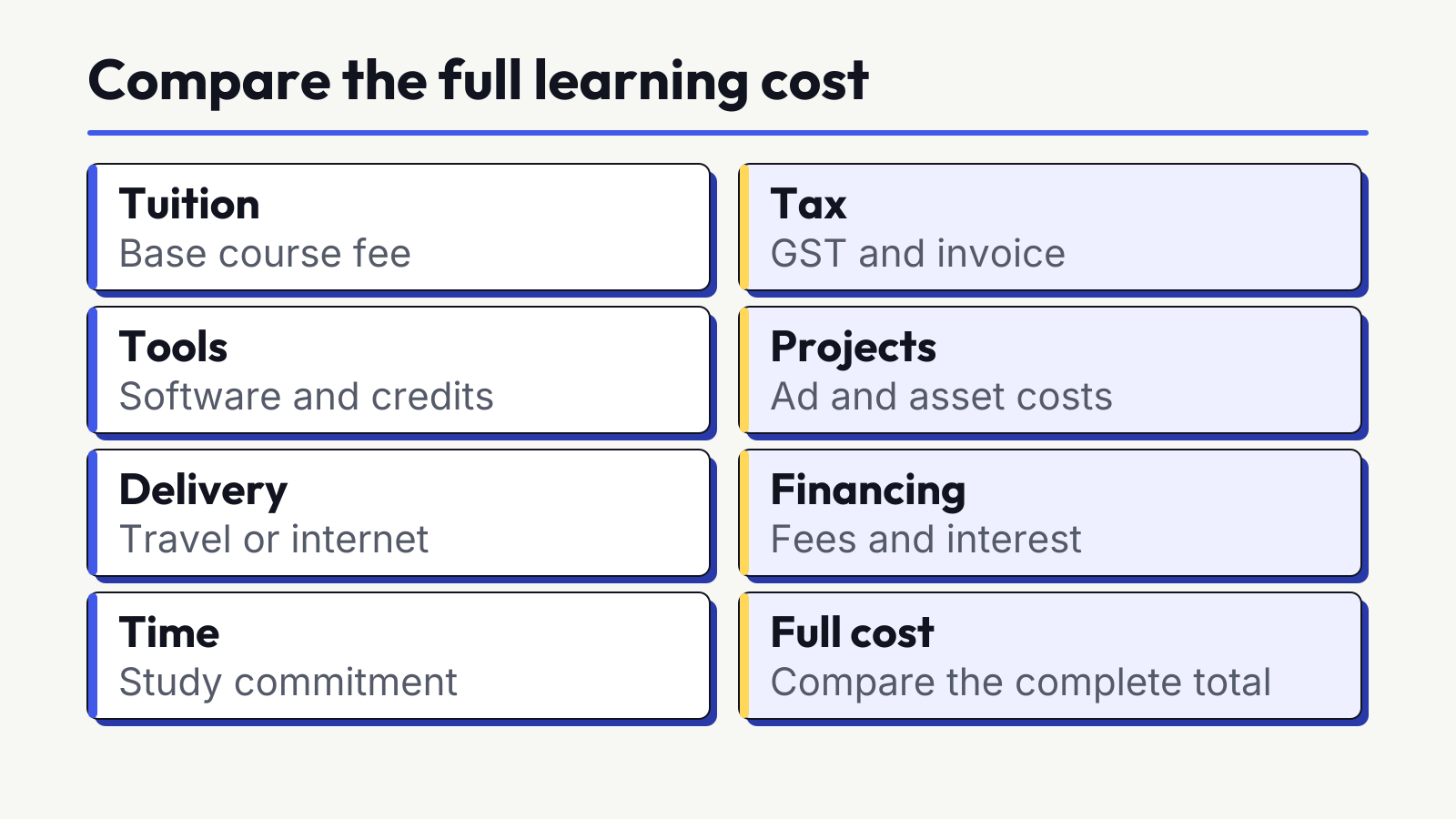
Total cost = tuition + applicable tax + required tools + project spend + travel or internet + financing charges. Record your weekly time commitment separately in hours.
- Tuition: The amount charged for instruction and standard course access.
- Tax: Ask whether the quoted amount includes or excludes GST and request a proper invoice.
- Tools: Include subscriptions, domains, hosting, design tools or required software.
- Project spend: Include ad budgets, printing, data or other materials needed to complete practical work.
- Delivery cost: Add travel and parking for classroom learning, or reliable internet and equipment for online learning.
- Financing: Add processing fees or interest where instalments use a third-party credit product.
A ₹30,000 course with ₹10,000 of required extras costs more than a ₹36,000 course that includes those items. The reverse can also be true if “included” access is limited or shared. Ask for precise terms.
What should be included in the fee?
A comprehensive fee proposal should answer the following questions without relying on vague phrases such as “all tools” or “complete placement.”
- Curriculum: Which channels, concepts and practical outcomes are taught?
- Live hours: How many hours involve instruction, guided practice, review and doubt clearing?
- Assignments: What work must each learner create independently?
- Feedback: Which assignments receive individual review, and who reviews them?
- Tools: Which named tools are included, under whose account and for how long?
- Project costs: Is campaign spend included, optional or paid separately?
- Learning materials: Are readers, recordings, templates and updates included?
- Assessment: What must you submit or demonstrate to complete the course?
- Career support: What resume, portfolio, interview or employer-introduction support is included?
- Commercial terms: What are the payment, refund, transfer and deferral rules?
Pro Tip
Replace “Do you provide practical training?” with “Show me one assignment, the feedback a learner receives and the improved final version.” The second question produces evidence you can compare.
Use cost per reviewed practice hour
Cost per teaching hour can be useful, but it treats a lecture and an individually reviewed task as equal. A stronger comparison separates total live hours from reviewed practice hours.
Cost per reviewed practice hour = complete payable amount ÷ hours in which your work receives guided review or correction.
| Example | Total cost | Live hours | Reviewed practice | Cost per reviewed hour |
|---|---|---|---|---|
| Course A | ₹30,000 | 60 | 10 | ₹3,000 |
| Course B | ₹42,000 | 90 | 28 | ₹1,500 |
| Course C | ₹55,000 | 120 | 20 | ₹2,750 |
This calculation does not prove that Course B is best. It reveals a question worth investigating: does its review process deliver useful, specific feedback? Use the number with sample work, trainer evidence and learner references.
How to evaluate EMI and instalment offers
An instalment plan can improve cash flow, but “EMI available” does not explain the terms. Ask for the cash price, total instalment price, down payment, number of payments, due dates, processing fee, interest, late-payment consequences and refund treatment. Confirm whether a financing company is involved and whether the institute receives the entire fee upfront.
Do not compare only the monthly amount. A lower monthly payment over a longer period can have a higher total cost. Keep the total payable amount in your comparison sheet.
Fee-related warning signs
- The fee changes during the counselling call but the revised amount is not documented.
- A large discount expires immediately, leaving no reasonable time to compare.
- The institute will not provide refund, transfer or deferral terms before payment.
- “Lifetime access” has no definition for content updates, platform availability or support.
- Tool access is advertised without naming the tool, account type, duration or usage limits.
- Project budgets or certification exam charges appear only after enrolment.
- Placement claims are presented as guaranteed outcomes without written conditions and verifiable evidence.
Should you choose online or classroom learning based on price?
Online courses often remove travel and classroom costs. Classroom programmes may provide easier face-to-face access, peer interaction and a fixed routine. Neither mode is automatically better value. Compare how the mode affects your ability to attend, practise, ask questions and receive feedback.
If you need a classroom schedule to remain consistent, a slightly higher local fee may be reasonable. If you learn independently and have a reliable setup, live online delivery may reduce the total cost. Recorded videos without live review should not be compared directly with a mentor-led live programme.
A five-step fee comparison process
- Shortlist programmes that match your goal, level, location and weekly availability.
- Collect a dated syllabus, timetable and complete written fee proposal from each provider.
- Calculate the true learning cost and reviewed practice hours.
- Verify the claims using a demo class, sample assignment, trainer profile and recent learner evidence.
- Compare the final two options after reading every payment and support condition.
SERA’s course overview explains the current programme structure. Because batch availability and commercial terms can change, request the current written quote through the SERA contact page before making a fee comparison.
Build a written fee comparison sheet
A good comparison sheet turns sales claims into fields that every provider must answer. Create one column for each course and use the same row labels. Record the date, tuition, tax treatment, tool costs, required advertising spend, travel cost, financing charges, live hours, reviewed practice hours, batch size, trainer name, project outputs and refund policy. Add a source beside every entry, such as a brochure page, email, fee quotation or course-page link.
Use three states for every field: confirmed in writing, stated verbally, or not answered. This distinction matters. A counsellor may accurately explain a benefit during a call, but the written terms are what you can review later. If an important field remains unanswered, do not fill it with an assumption. Mark it clearly and ask again. Use the same record to evaluate a digital marketing institute on evidence, alongside the full cost.
Separate features from evidence. “Portfolio support” is a feature. A sample brief, feedback rubric and anonymised learner portfolio are evidence. “Placement assistance” is a feature. A written explanation of eligibility, activities and recent employer interactions is evidence. The goal is not to distrust every claim. It is to compare claims consistently.
Finally, add a confidence score beside the total price. You might use high confidence when the amount and inclusions appear on a dated quotation, medium confidence when some extras remain estimated, and low confidence when the proposal depends on verbal assurances. A precise total with low confidence is not yet a reliable buying decision.
Match the fee to your learning stage
The same course can be good value for one learner and poor value for another. A complete beginner may benefit from structured foundations, repeated guided practice and frequent correction. Someone already managing campaigns may need a narrower advanced programme, stronger analytics work or specialist mentoring rather than another broad introduction.
If your goal is to enter a junior role, ask whether the course helps you produce credible beginner work: a keyword map, an SEO brief, a campaign plan, ad variations, an analytics report and a presentation explaining your decisions. If you run a small business, value may come from applying the work to your own site and campaigns. If you are changing careers, the timetable, feedback cadence and portfolio process may matter more than access to another large video library.
Do not pay for breadth you are unlikely to use, but do not remove essential foundations only to lower the price. Search, content, paid media, measurement and basic conversion thinking affect one another. A course that teaches isolated tool clicks without explaining this relationship may feel practical while leaving important gaps.
Before paying, write one sentence describing the change you expect by the end of the programme. Then list the three pieces of evidence that would demonstrate that change. A useful fee decision connects the payable amount to those outcomes, the work required to reach them and the support available when you struggle.
Frequently asked questions
What is the average digital marketing course fee in Ahmedabad?
There is no official regulated average for private digital marketing training. Public pages reviewed in October 2026 show short programmes around ₹15,000 to ₹25,000, comprehensive options around ₹30,000 to ₹70,000 and extended programmes at ₹1 lakh or more. Compare scope and complete cost before using a range.
Is a cheaper course a bad choice?
No. A lower-cost course may suit someone who needs a focused introduction. Check teaching hours, assignments, feedback and exclusions. Check whether the course covers the outcomes you need before comparing prices.
Are tools normally included in the course fee?
Policies differ. Some programmes include learner access to named tools, while others use free plans or trainer demonstrations. Ask for the tool name, account type, access period and any limits in writing.
Does paying more improve placement chances?
Price alone cannot guarantee employment. Look for practical work, portfolio evidence, feedback quality, interview preparation and clear placement-assistance terms. Your attendance, work quality and employer requirements also affect the outcome.
What should I request before paying?
Request a dated curriculum, timetable, complete fee and tax breakdown, instalment schedule, tool and project-cost list, refund and deferral policy, attendance requirements, assessment rules and written description of career support.
Ask for SERA’s current written fee, inclusions and batch details before comparing your shortlist.