Key takeaways
- Your degree gives you transferable strengths, but you still need to connect them to marketing tasks and evidence.
- Choose a course, internship or self-study route by the feedback and responsibility you need, not by speed alone.
- A credible beginner portfolio shows the brief, research, decisions, first version, feedback and revision.
- Use a focused 12-week plan to move from foundations to portfolio evidence and carefully targeted applications.
- SERA’s 16-week beginner programme combines six modules, live practice, feedback and an integrated capstone.
A digital marketing course after graduation can give you a place to apply what you already know. A BCom graduate might start with campaign costs and margins, while a BA graduate might begin with audience interviews or writing a brief.
This guide gives graduates a degree-specific entry plan without assuming one academic background is automatically better. Use it to map transferable skills, identify gaps, choose a learning route, build a small portfolio and make better-targeted applications.
Is digital marketing a practical path after graduation?
It can be practical if you are willing to combine communication, customer understanding, channel execution and measurement. Digital marketing is not one job. Content, SEO, paid media, social media, analytics, lifecycle work and coordination use different mixes of writing, research, numerical reasoning and technical confidence.
Begin by testing the work instead of committing to a job title. Research an audience, draft a content brief, review a landing page, map a simple search journey and explain a small dataset. Notice which tasks hold your attention and which ones require deliberate improvement. That evidence is more useful than choosing a specialisation because its name appears frequently online. Use what you learn from the tasks to choose a marketing career path in Ahmedabad.
Start with what your degree already gives you
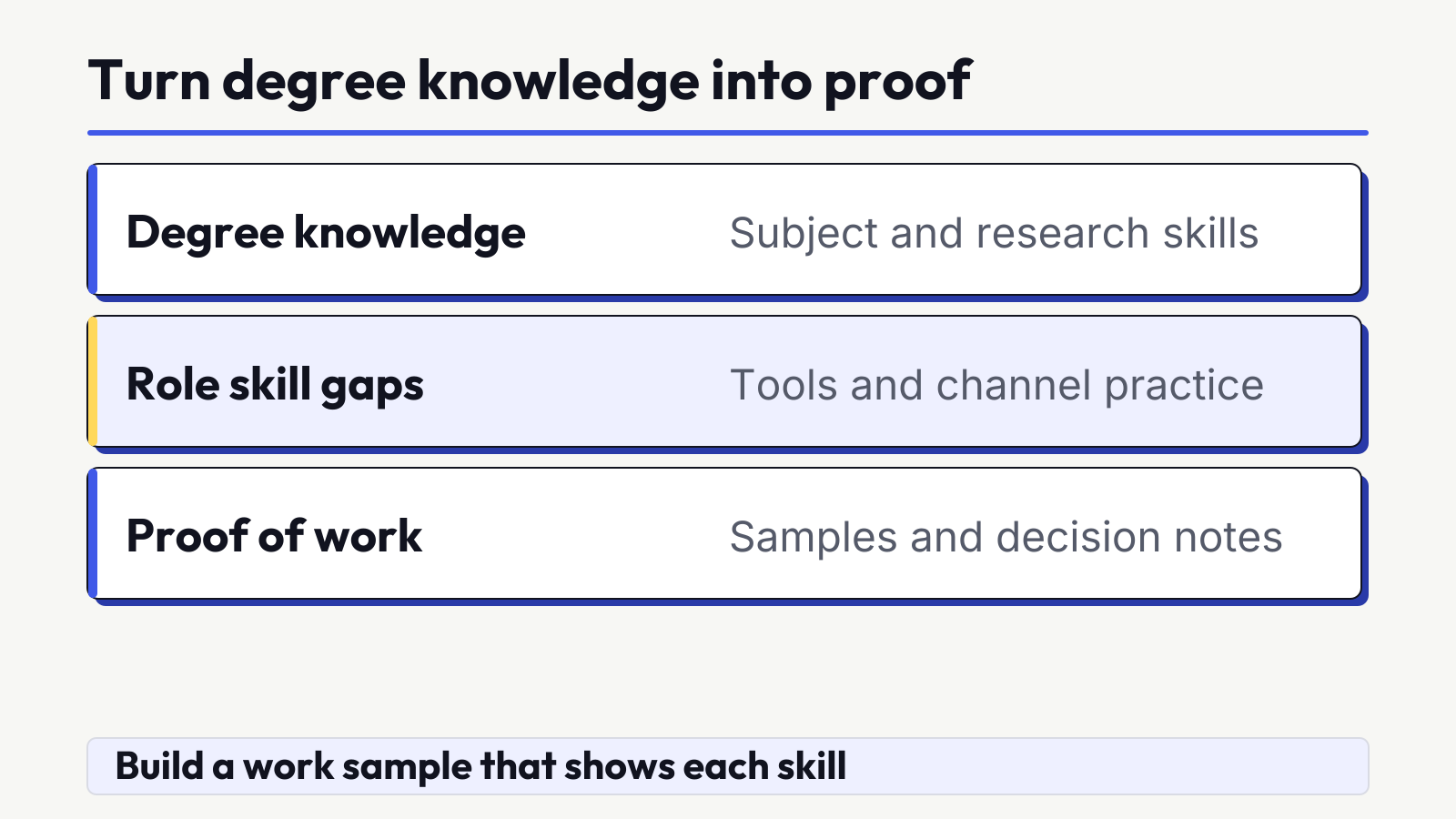
Your degree may have developed research, writing, presentation, business, data or systems habits. Transfer happens only when you apply those habits to a marketing problem. “I studied commerce” is background. “I used spreadsheet analysis to explain a campaign budget and recommend a test” is evidence.
- List three assignments that required research, analysis or communication.
- Write the method you used, not only the subject studied.
- Connect each method to a beginner marketing task.
- Mark the missing tool, concept or feedback needed to produce a credible sample.
Map degree-specific strengths and skill gaps
| Degree | Possible starting strengths | Gaps to test | Useful first portfolio output |
|---|---|---|---|
| BA | Research, writing, interpretation, culture and communication | Spreadsheets, measurement and commercial objectives | Audience insight translated into a content brief and page outline |
| BCom | Business concepts, accounting, economics and numerical comfort | Customer language, creative development and channel execution | Campaign budget with assumptions, measures and a decision note |
| BBA | Management, presentations, market concepts and project coordination | Hands-on production, platform detail and evidence quality | Integrated campaign plan with channel roles and a reporting view |
| BCA | Systems thinking, web concepts, data structure and technical confidence | Positioning, persuasive writing and audience empathy | Website or SEO review that connects technical observations to user needs |
| Engineering | Problem framing, quantitative reasoning, testing and documentation | Brand context, concise writing and qualitative customer research | Landing-page experiment plan with hypothesis, evidence and limits |
Do not let the table choose a path for you. A BA graduate can excel in analytics, and an engineer can become a strong content strategist. Pick one familiar strength and one uncomfortable gap, then design a project that requires both.
Choose between a course, internship and self-study
Choose the route that supplies the missing part of your learning system. A structured course is useful when you need sequence, live explanation, guided practice and feedback. An internship is useful when the organisation offers supervised responsibility and the work is clearly defined. Self-study is useful for orientation or a focused gap when you can plan, produce and seek external critique.
- Choose a course when: your knowledge is fragmented and you need a broad beginner foundation.
- Choose an internship when: you have basic skills and can verify the supervision, tasks and learning conditions.
- Choose self-study when: you can define a narrow outcome and obtain credible feedback.
- Combine carefully when: the schedules leave enough time to revise work rather than merely attend.
Pro Tip
Ask an internship provider who reviews your work, what a normal first-month task looks like and whether you will receive feedback. Access to a workplace is not the same as structured learning.
Build portfolio evidence before applying
Build two or three complete case narratives before sending many applications. Use a fictional or clearly labelled practice brief when you do not have a client. Never invent results, access or business relationships.
- Brief: Define the audience, problem, goal, channel and constraints.
- Evidence: Record sources, observations, assumptions and limitations.
- Execution: Create the brief, page, audit, campaign structure or report.
- Feedback: Obtain comments against stated criteria.
- Revision: Show what changed and why.
- Reflection: State what you would test next without claiming an outcome.
Tailor the evidence to the responsibility you want. A content-oriented sample should show audience insight and editing. An SEO sample should connect search observations to page decisions. A performance-marketing sample should connect audience, creative, landing page, budget, tracking and testing. An analytics sample should separate observation, insight and action. Use these responsibilities to build a portfolio for the role you want rather than collecting unrelated samples.
Follow a 12-week entry plan
Use twelve weeks as a planning frame, not a promise of job readiness. Adjust the pace around your starting level and responsibilities.
- Weeks 1 to 2: Learn marketing foundations, audience, positioning, journeys and channel roles. Write a one-page audience and offer brief.
- Weeks 3 to 4: Study content, webpages and basic search intent. Create a content brief and landing-page outline.
- Weeks 5 to 6: Explore SEO and AI-assisted search foundations. Produce a small topic map and on-page review.
- Weeks 7 to 8: Learn paid-media and social basics. Draft a campaign structure, creative idea and measurement plan without claiming results.
- Weeks 9 to 10: Review analytics concepts and reporting. Turn a sample dataset into observations, insights and actions.
- Weeks 11 to 12: Integrate the strongest work, request feedback, revise, prepare a concise portfolio and target relevant applications.
Pro Tip
Schedule a revision week before you schedule an application week. Sending unfinished portfolio work faster rarely improves the quality of your evidence.
Move from learning to applications
Read the responsibility list before using a job title as your target. Compare the required tasks with your current evidence. If a role asks for content briefs, spreadsheets and basic reporting, your application should point to samples that demonstrate those actions. Do not claim platform experience you only observed in a demonstration.
Use the official National Career Service portal as one source for career information and opportunities, while checking the current employer, role and application details directly. A listing or occupational description does not guarantee availability, selection or suitability.
- Tailor the opening summary to the actual tasks in the description.
- Link each claimed skill to a specific portfolio example.
- State clearly when work is simulated, academic or supervised.
- Prepare to explain a revision, not only the final output.
- Track applications and identify repeated evidence gaps.
When to choose a broad beginner programme
A broad programme may suit you when you know channel names but cannot connect them into one customer journey, campaign or measurement system. It can also help when your degree built useful general skills but offered little supervised marketing execution.
Choose a narrow course only when you understand the wider system and can explain why the specialisation fits your evidence and goal. Otherwise, a tool-focused programme can teach button sequences without the audience, message, landing-page, tracking and business context needed to make sound decisions.
Questions to ask before enrolling
- Does the course assume previous marketing experience?
- How do the modules connect rather than operate as separate tool lessons?
- What portfolio outputs will I create and revise?
- Who reviews learner work, and how specific is the feedback?
- What are the live hours, practice expectations and maximum batch size?
- Are recordings part of the standard package?
- Which tools, accounts and additional costs are required?
- What does placement support include, and what is not guaranteed?
- Can the provider show an anonymised assignment, feedback and revised version?
Ask for written answers and compare them against your degree-specific gaps. A clear course may still be the wrong course for your goal. Fit matters more than the number of modules or certificates advertised.
Review SERA’s course structure
SERA’s beginner Digital Marketing Course runs for 16 weeks with three live two-hour sessions each week. That is 48 live sessions and 96 live hours. It is offered through offline classes in Ahmedabad and live online delivery, with maximum batch sizes of 25 offline and 40 online. Available slots depend on demand, so request current written information.
The six modules cover Marketing Foundations, Content Marketing, SEO and AI Search, Performance Marketing, Social Media, and Analytics and Capstone. The programme is designed to move through explanation, practice, feedback, revision and integrated application. Searchable reference PDFs support both formats, while offline learners also receive printed module readers. Recordings are not a standard part of the learner package.
A successful learner should be able to produce and explain beginner-level work across the connected modules and present a portfolio-ready capstone. SERA does not guarantee placement, income or a particular result. Explore the current course structure, learn more about SERA, or ask about fit for your degree and starting level.
Frequently asked questions
Can I enter digital marketing after a non-marketing degree?
Yes. Start by mapping transferable strengths from your degree to specific marketing tasks, then build evidence for the gaps. A non-marketing degree does not remove the need for foundations, practice and feedback.
Which degree is best for digital marketing?
No single degree is universally best. BA, BCom, BBA, BCA and engineering graduates can bring different strengths. Employers and roles set their own criteria, so focus on relevant tasks, evidence and clear communication.
Should I take a course or apply for internships first?
Choose a course if you need structured foundations and feedback. Consider an internship when you can verify the supervision and tasks and already have enough basics to contribute. Some learners combine them carefully.
How many portfolio projects do I need as a beginner?
There is no fixed number. Two or three complete projects with a clear brief, evidence, execution, feedback and revision are usually more useful than many disconnected screenshots.
Does a digital marketing course guarantee placement?
No. A course can support skills, portfolio development and application readiness. Selection depends on the employer, role, your evidence, communication, interviews and other factors.
Map your degree strengths first, then compare them with SERA’s beginner course structure and feedback model.
Research date: 30 October 2026. Verify current course details, role requirements and application information on the relevant official source before making a decision.

Mehul Shah
Mehul Shah is the founder and academic director of Sera Digital Marketing Academy in Ahmedabad. He has more than 11 years of experience in SEO, SaaS marketing and agency work. He writes about SEO, AI search and digital marketing, with a focus on how to audit websites, plan campaigns and measure results.